Wayne Quality Roofing brings more than 20 years of work to roofing in Airmont, and every job here starts by finding out what the roof actually needs. On a leak call that means a look in the attic as well as on the shingles, so the water is traced to the point where it really gets in before a single line is priced.
A roof job in this village can carry paperwork a homeowner might not expect. After a fire, a fallen tree or a hard storm, the question is sometimes not only how to fix the roof but whether the house may be put back the way it stood. We plan the work around that question instead of discovering it halfway through.
Our written scopes give tear-off, decking, underlayment, flashing, ventilation and gutters their own lines, so you can set our number beside another roofer’s and compare them item by item. And you get a plain answer on whether a repair will hold before replacement comes up at all.
When Roof Damage in Airmont Becomes a Zoning Question
A Rule Written for Damaged Buildings
Airmont’s zoning chapter, Chapter 210, has an article on nonconforming uses, buildings and lots. Section 210-133D, as reproduced in the village’s 2025 and August 28, 2026 draft amendments, covers a building that holds a nonconforming use or is noncomplying as to bulk and is damaged by fire or other causes. If that damage reaches 75% of last full value, the building may only be repaired or rebuilt in conformity with the current chapter.
The measure is the whole building, not the roof alone. Value comes from the Town Assessor’s records, and the assessed value of the land is left out of the figure. A house that fully conforms sits outside this section entirely, which is why the first step after serious damage is learning which kind of house you own.
Below the Threshold, a Deadline
Damage under that line still carries a condition. The same section says such a building may be repaired, provided that a building permit is obtained within one year after such damage. Miss that window and the code says the structure must afterward be occupied only by a conforming use and meet the bulk requirements of the chapter.
That is a real consequence for an owner who waits. A partial loss that could have been repaired as it stood can turn into a project held to today’s setbacks and height limits, simply because the application was filed too late.
Normal Upkeep Is Treated Differently
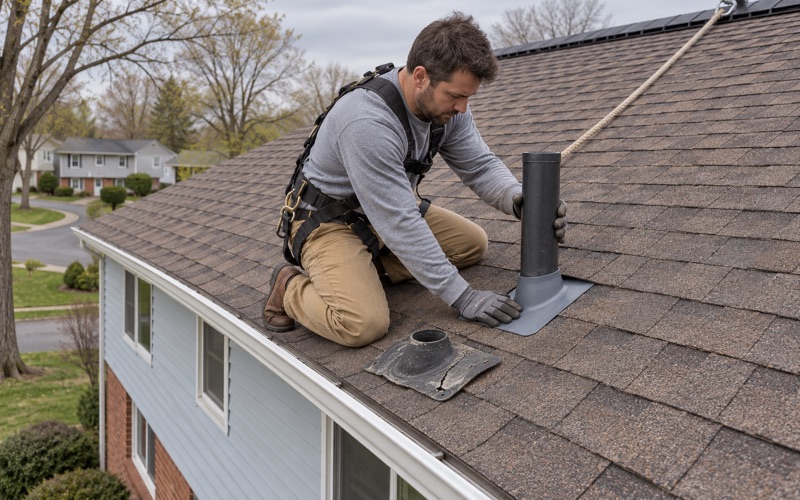
Section 210-133A keeps normal maintenance and repair permitted, as long as the work does not extend the nonconforming use. Replacing a handful of blown shingles or resealing a pipe boot is a different matter from rebuilding a burned rear wing, and the village draws that line in its own code. We describe our scope clearly so you and the village can see which side of it a job sits on.
The damage section is written around a loss from fire or other causes, not around a roof that has simply reached the end of its life. Where a job falls somewhere between the two, the Building Department’s reading is the one that counts, and we ask for it before anything is torn off.
Looking for roofing closer to Dumont? See Roofing Services in Dumont.
The One-Year Clock and Houses Older Than the Village
Why the Calendar Matters After a Storm
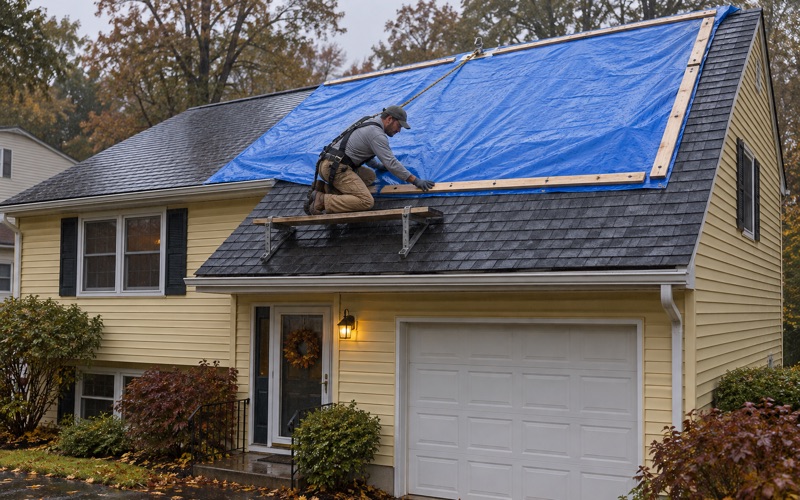
When a tree comes through a roof or a fire takes part of an attic, the first weeks go to tarps, phone calls and finding somewhere to stay. On a house the zoning rule reaches, those weeks count against the deadline. We put tarps and temporary repairs on the same day after a wind storm, with photos taken before anything is moved, so the house is protected while the permit question gets answered.
The village’s application form says a building permit, once issued, is good for two years. What section 210-133D asks is that the permit be obtained inside the first year, so the application date, not the finished roof, is the one to watch.
Houses Built Before Airmont Had Its Own Zoning
Airmont was incorporated in 1991 from the hamlets of Tallman, Airmont and South Monsey, and the village code still refers to subdivisions approved previously by the Town of Ramapo Planning Board. Much of the housing came first. Census figures for the village show 1,915 of its 2,588 housing units were built before 1990, and 1,012 of them went up during the 1960s alone.
A house built under earlier rules is not automatically nonconforming, and we never assume one is. Whether a given home is noncomplying as to bulk is a question for the village, and it is worth asking before a damaged roof becomes a rebuild.
What Those Older Roofs Need From Us
Most homes here are one-unit detached houses, 84.2% of all units by the same census count. Where those houses are capes, ranches or split-levels with low, ice-dam-prone eaves, they get an eave membrane and a ventilation check from us rather than just a new layer of shingles, because ice dams start where warm attic air meets a cold overhang.
Attic ventilation is checked on every replacement we do, since a roof that cannot breathe ages from underneath no matter how good the shingles are. On a house of that age, the soffit intake can be the part that was painted over or blocked years ago, and a ridge vent without intake moves very little air.
What the Airmont Building Department Asks a Roofer For
Who Decides Whether a Re-Roof Needs a Permit
New York has no statewide re-roof exemption. The state’s Uniform Code rule at 19 NYCRR 1203.3(a) lets a local program exempt only listed categories of work, and roofing is not among them. The Village of Airmont Building Department decides how a given roof job is treated.
The department sits at 251 Cherry Lane and answers at (845) 414-5536. We call before work starts rather than guess, and we tell you what we were told so the decision is on record for your house.
The Contractor Paperwork in the Packet
The village’s building permit application asks every residential contractor for a copy of its Rockland County Home Improvement License, along with certificates of insurance for workers’ compensation, disability and liability. The same certificates are required for every subcontractor on the job, so it pays to ask any roofer you are considering for that set before you sign.
If a homeowner does the work, the form takes a different path. It calls for a signed, notarized statement, the state’s CE-200 exemption form and the homeowner’s own liability insurance in place of the contractor documents.
Inspections Are the Owner’s Call
The application puts that duty plainly: it is the homeowner’s responsibility to call for all required inspections. We keep you posted on where the roof stands, so you know when the work is ready to be seen and nothing gets covered before the inspector has looked.
Fees follow the village schedule set by Resolution 18-4011, which starts at $125 for building work valued under $1,000 and rises with construction value. The Building Inspector may set that value from RS Means, which is one more reason a clear, itemized scope is a useful document to have on hand.
The Certificate at the End
Permitted work closes with a Certificate of Occupancy or Compliance. The village form warns that lacking one will cause serious problems when you decide to sell or refinance your home, which makes it worth closing out every permit rather than letting one sit open.
When an owner is getting ready to sell, we also write a roof condition report the seller can hand to the buyer’s inspector. It sits beside the village certificate as a description of the roof, not as a substitute for it.
Documenting the Damage Without Handling the Claim
Photographs Before Anything Moves
After a storm or a fallen limb, we photograph the damage and write it up for your own claim before a tarp or a cleanup crew changes the scene. Here that record does two jobs: it supports your insurance file, and it fixes the condition of the house on a date, which matters if the one-year permit deadline applies.
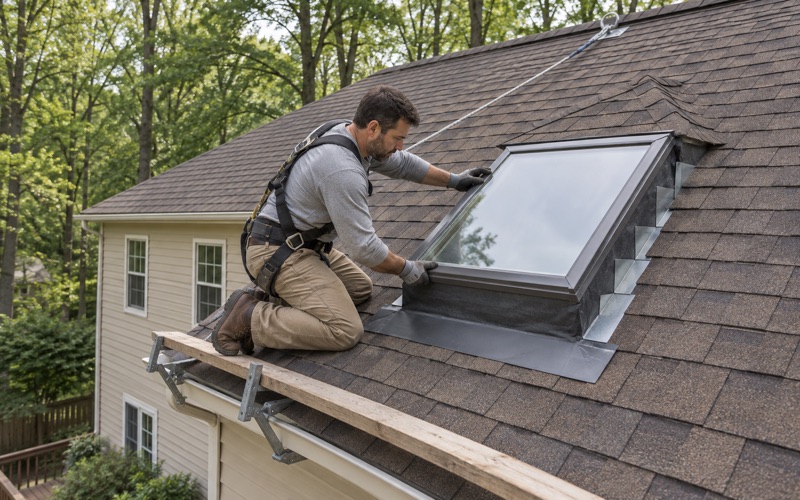
Wooded lots get their own notes. Overhanging limbs, valleys packed with leaves and shaded, mossy slopes are called out in the estimate, so the cause of a leak is written down rather than left to memory.
What a Roofer Can and Cannot Do With a Claim
New York Insurance Law section 2101(g)(2) treats anyone who, for compensation, acts or aids on behalf of an insured in negotiating or effecting a claim settlement as a public adjuster, and contractors are not among the exclusions. So our part is documentation and attendance.
The crew will meet your insurance adjuster on site when you ask, point out what we found and answer questions about the roof itself. The settlement stays between you and your insurer, and we price the work on its own terms.
Repair First, Replacement Second
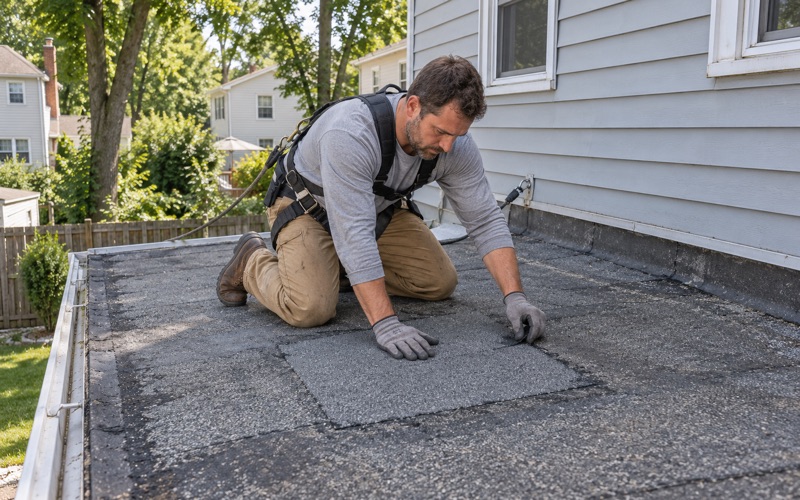
A partial loss does not always mean a full roof. Where the decking is sound and the damage is confined to one slope or one valley, we say so and price the repair on its own, before replacement is ever discussed. That answer also tells you early what the permit application will need to describe.
When replacement is the honest answer, the written scope lists each part separately. You see what the tear-off costs, what the underlayment and flashing cost and what happens at the gutters, which makes a second estimate easy to hold up against ours.
Decking, Flashing and Cleanup on the Rebuild
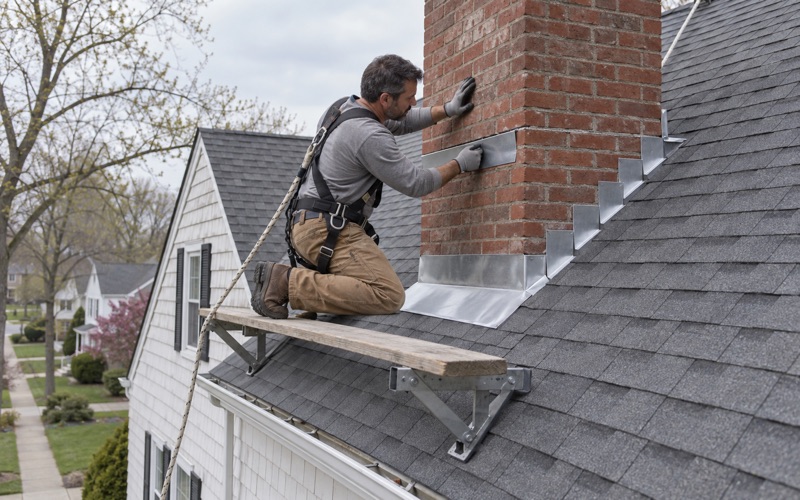
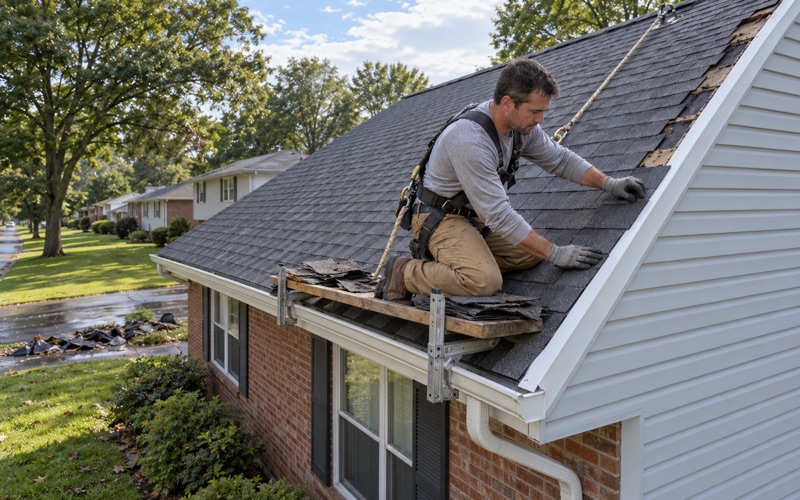
Once the old roof is off, damaged decking is photographed and shown to you before it is replaced, at a per-sheet price already set in the contract. Step, counter and chimney flashing is replaced with the roof, never reused under new material, because old metal is where a new roof most often starts to leak.
At the end of every work day the driveway, yard and gutters are cleaned, finished with a magnet sweep for roofing nails. A house already dealing with storm damage should not also be dealing with nails in the tires.
- 20+ Years in Roofing
- Line-Item Written Estimates
- Same-Day Storm Tarping