Wayne Quality Roofing brings more than 20 years of roofing in Dumont and across northern New Jersey to every job, and some of the most urgent calls we take start with a tree. A limb that comes through a roof is not one problem but two, and they have to be solved in the right order. The opening gets closed first, and the wood beneath it gets judged second.
That order sounds obvious, yet storm season keeps producing roofs where it was reversed. A crew rushes to quote shingles while water is still finding its way into ceilings, or a hole gets covered with a tarp and nobody ever goes back to look at the rafters underneath. Both mistakes cost the homeowner money later, usually as a soft spot or a stain that keeps returning.
This page walks through how we handle a tree strike from the first phone call to the final estimate. It covers the storm that put this borough on the federal weather record, what a falling limb actually does to an older roof deck, how we dry in an opening the same day, and how we decide between a patch, a section and a full replacement.
March 13, 2010: The Nor’easter on Dumont’s Storm Log
What the Spotter Reported
On the afternoon of Saturday, March 13, 2010, a nor’easter put Dumont onto the National Weather Service’s local storm-report log. A trained spotter reported numerous trees down with power lines and road closures across the borough, and the same report was filed for several neighboring towns. The rest of the Bergen County log that day filled with reports of trees landing on houses.
Wind was measured elsewhere, not in the borough itself. The weather station at Teterboro logged a 59 mph gust that evening, and power was cut across the region, with PSE&G reporting about 459,000 customers without service at the height of the storm. For homeowners here, the record is trees, wires and blocked streets, which is exactly how most roof damage in a storm like this begins.
The Selzer School Roof
The clearest roof damage in town that weekend was at the Selzer School. Part of the roof was torn away, leaving 12 middle school classrooms unusable, with broken windows, roof leaks and water in the ventilation equipment. Blocked roads and outages closed every Dumont school, and the closure ran into Tuesday, March 16 because of residual storm damage.
The school story is worth knowing for what it shows about sequence. Once a roof opens, water does not stay at the hole; it travels into whatever sits below, including mechanical equipment and ceilings well away from the visible damage. A house roof behaves the same way, which is why we treat the first hours after a strike as the part of the job that sets every cost afterward.
Rain on Top of Wind
The storm was not only wind. Over the week ending March 16, parts of Bergen County saw 6 to 8 inches of rain, and the event became federal disaster DR-1897-NJ, with Bergen County designated for both individual and public assistance. A tree strike that is then rained on for days is the combined failure that week recorded, and it is the scenario our storm process is built around.
Looking for roofing closer to Totowa? See Roofing in Totowa.
What a Falling Limb Does to an Older Roof Deck
Why the Age of the Housing Matters
In Dumont, 70.9% of homes were built before 1960, and nearly half predate 1950. Roofs of that era were commonly decked with board sheathing or early plywood, and some have carried more than one layer of shingles over the decades. Wood of that age can be perfectly sound, but it has also had a long time to absorb attic moisture, and a sudden point load finds any weakness quickly.
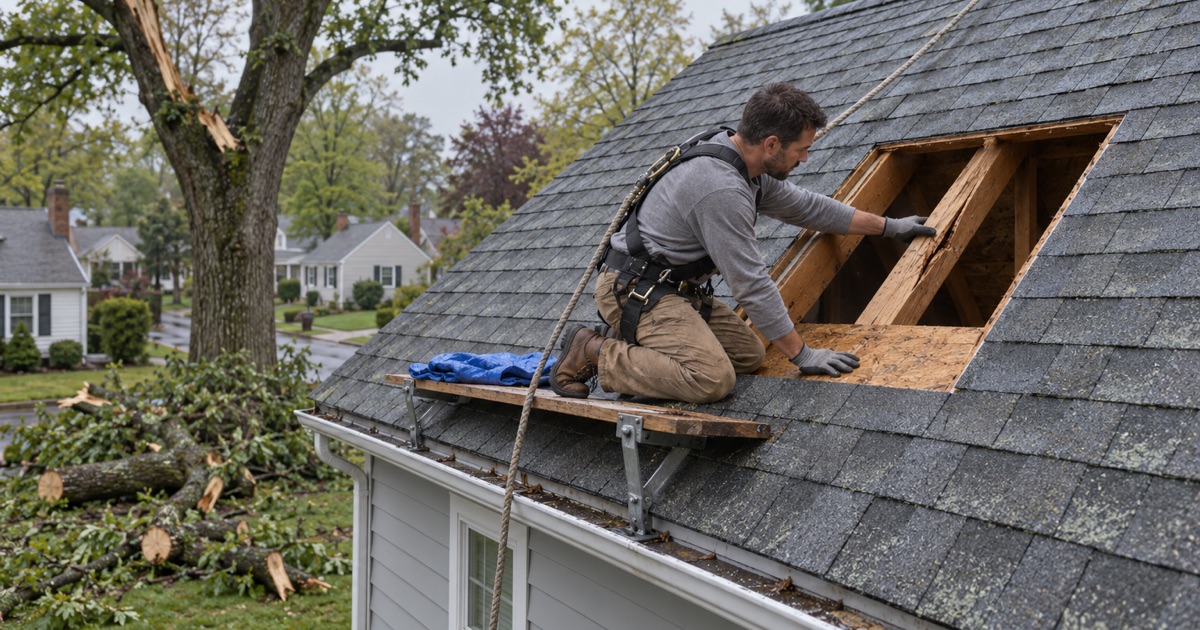
A heavy limb rarely makes a clean hole. It tends to crack the decking along a span, split boards well beyond the puncture, and push nails up through the shingles in a ring around the impact. From the driveway, the damage can look like a few torn tabs; from the attic, it can look like a cracked board running several feet in either direction.
Damage You Cannot See From the Ground
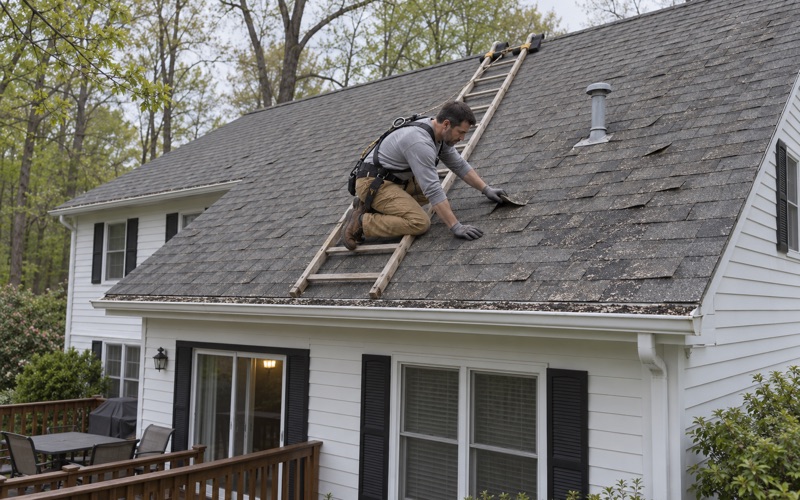
That is why every storm call we take includes a look in the attic as well as on the roof. Staining on the underside of the decking, daylight through a split, a rafter that has shifted on its seat, or wet insulation tells us where the water actually went. We trace the leak to its real entry point before anything is priced, because the visible tear is often not the whole story.
Gutters and fascia take hits too. A limb that slides off the roof edge can bend a gutter run, pull the drip edge loose, or crush an eave where rot was already starting. We note each of those separately, so the owner can see which damage came from the tree and which was already there before the storm.
Chimneys and Flashing
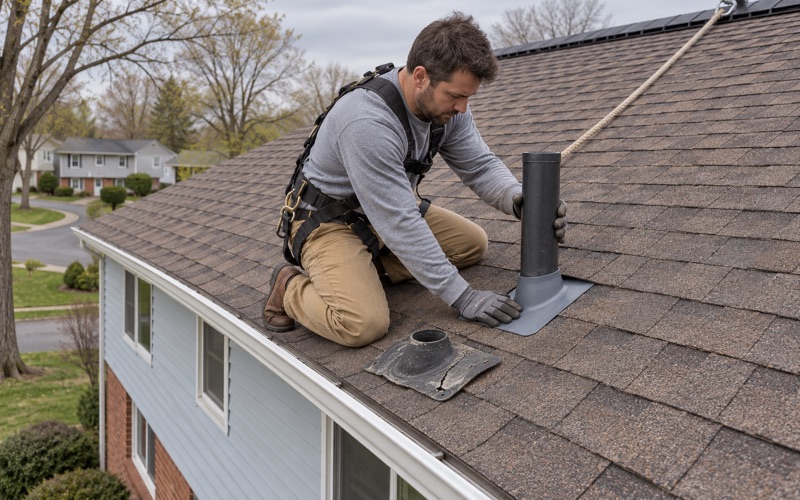
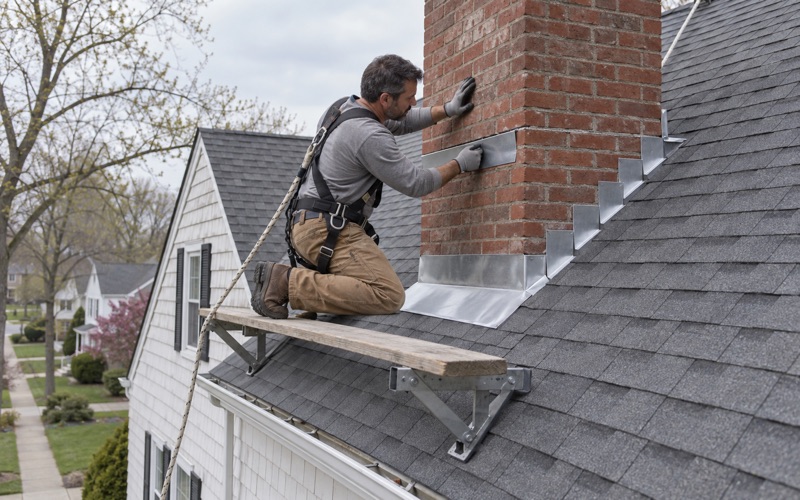
Houses from this era often have chimneys, and a branch that glances off one can crack the crown or open the step flashing along its sides. We check both even when the main strike landed elsewhere. When a section of roof is replaced around a chimney, the step, counter and chimney flashing are replaced with it rather than bent back into place under new shingles.
Drying In the Opening the Same Day
Limb Off, Tarp On
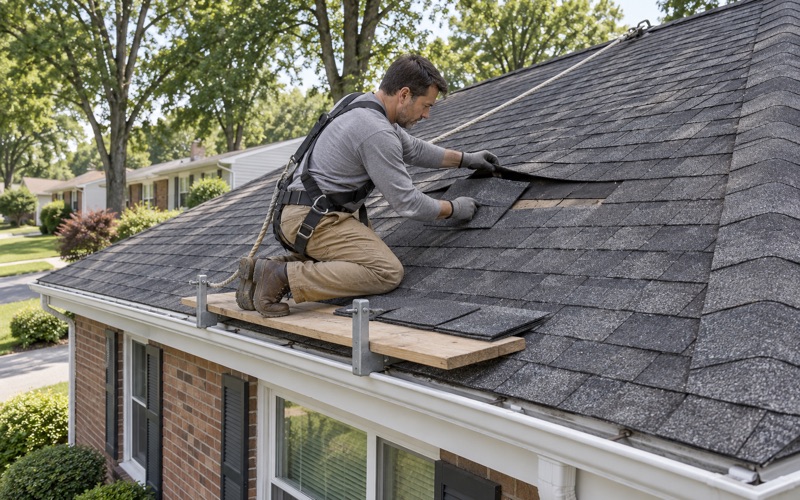
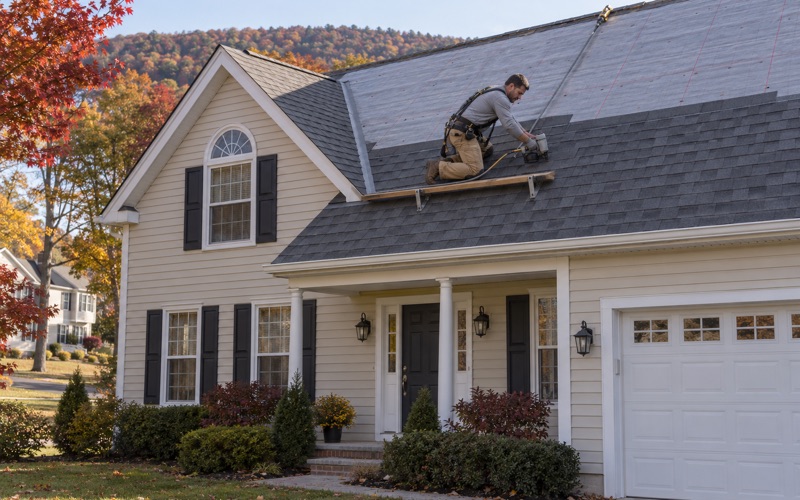
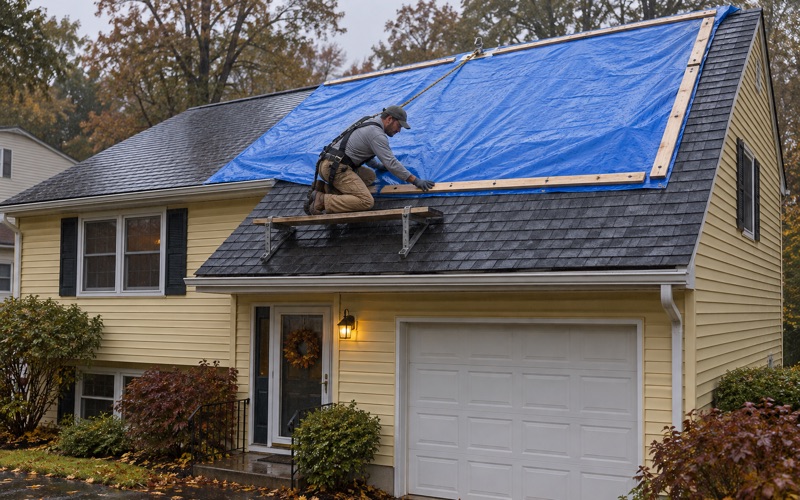
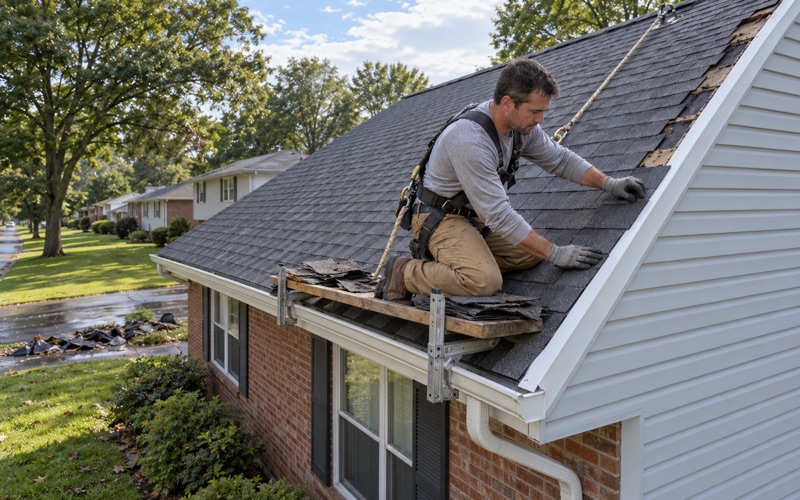
After a wind storm, our crew puts tarps and temporary repairs on the same day. Once the limb is clear of the roof, we cover the opening, secure the tarp over sound framing rather than broken edges, and seal the perimeter so wind cannot get under it. On a pitched roof that means battens fastened through the tarp into solid wood, not sandbags left to slide.
A tarp is a temporary measure, not a repair. It buys time, usually days or a few weeks, while the decking and framing get evaluated and the owner decides what comes next. We tell every homeowner how long that particular cover should be trusted, and what to watch for inside the house while it stays on.
Photos Before Anything Moves
Before a single branch or shingle is moved, we photograph the damage from the ground, from the roof and from the attic. Those pictures matter later, both for the owner and for anyone who needs to understand what happened. We write up the storm damage for the homeowner’s own claim, and when asked, our crew will meet the insurance adjuster on site to walk the roof together.
We do not file, manage or negotiate claims; in New Jersey that work belongs to the owner or to a licensed public adjuster under the Public Adjusters’ Licensing Act. The Department of Banking and Insurance notes that it can help to have the contractor speak with the adjuster, and that is the limit of our role. Whether a policy pays for any part of a tree strike is between the owner and the carrier.
Protecting the Interior
Water that got in before the tarp went on keeps moving. We point out wet insulation, saturated drywall and any ceiling that is starting to sag, and we recommend the owner deal with them quickly, since a roof can be made watertight while the room below is still holding moisture. Drying out the attic is part of drying in the house.
Rafters, Decking and the Repair-or-Replace Decision
Checking the Structure Under the Strike
Once the opening is covered, we judge the wood before quoting any shingles. That means looking at every rafter in the impact zone for cracks, splits at the ridge or the wall plate, and any sag in the roof plane. A cracked rafter needs to be sistered or replaced, and that framing work is a different job from re-covering a roof.
Structural repair after a tree strike can raise questions that a simple re-roof does not. Before any framing is touched, we confirm with the Dumont Building Department what that part of the work requires, and we tell the owner what we learned. It is better to settle that question before the estimate than to discover it halfway through the job.
Decking Shown Before It Is Replaced
Damaged decking that turns up once the old roof is off is photographed and shown to the owner before it is replaced. The per-sheet price for that replacement is set in the contract ahead of time, so a homeowner is never surprised by a decking line that appears only after the shingles are gone. On older houses like most of those here, that clause matters more than usual.
Patch, Section or Full Replacement
We give a straight answer on whether a damaged roof can be repaired before replacement is ever discussed. A clean puncture on a roof with good remaining life is often a patch: new decking, new underlayment and matched shingles over the strike. If the impact cracked decking across a larger area, replacing the whole slope may make more sense than stitching new material into old.
A full replacement becomes the honest answer when the strike exposes a roof that was already near the end of its life, or when the decking shows widespread rot that the tree only revealed. In that case, the storm damage and the age of the roof are written up separately, so the owner understands which part of the cost the storm actually caused.
Reading the Written Scope
Every estimate we write lists tear-off, decking, underlayment, flashing, ventilation and gutters as separate lines. After a storm, when several contractors are often walking the same street, that format lets an owner compare two quotes item by item instead of guessing what a single lump sum includes. Our contracts follow New Jersey’s home improvement rules, including the three-day cancellation notice.
Looking Up Before the Next Storm
A tree strike is also a reason to look at what is still hanging over the house. On wooded lots, our estimates call out overhanging limbs, leaf-packed valleys and shaded, mossy slopes, so the owner knows which branches over the roof deserve attention from a tree professional. At the end of each work day, the driveway, yard and gutters are cleaned, including a magnet sweep for roofing nails.
- 20+ Years in Roofing
- Line-Item Written Estimates
- Same-Day Storm Tarping