Wayne Quality Roofing handles flat roof repair in Wayne, NJ, serving surrounding cities including Totowa, Pequannock, Lincoln Park, Franklin Lakes and Woodland Park. On houses, flat and low-slope roofs turn up over porches, additions, attached garages, dormers and the back of many split-levels. With more than 20 years in roofing, we work on modified bitumen, EPDM, TPO and PVC, the membranes these roofs actually use.
Flat roofs fail differently from shingle roofs. Water does not run off quickly, so a small opening at a seam or a wall can let in a lot of water, and the leak often appears far from where it started. We start every repair by finding the real entry point from above and below.
You get a written repair scope naming the membrane, the defect and the fix, along with an honest view of how much life the roof has left. If repair no longer makes sense, we say so.
Flat Roof Materials We Repair
Modified Bitumen
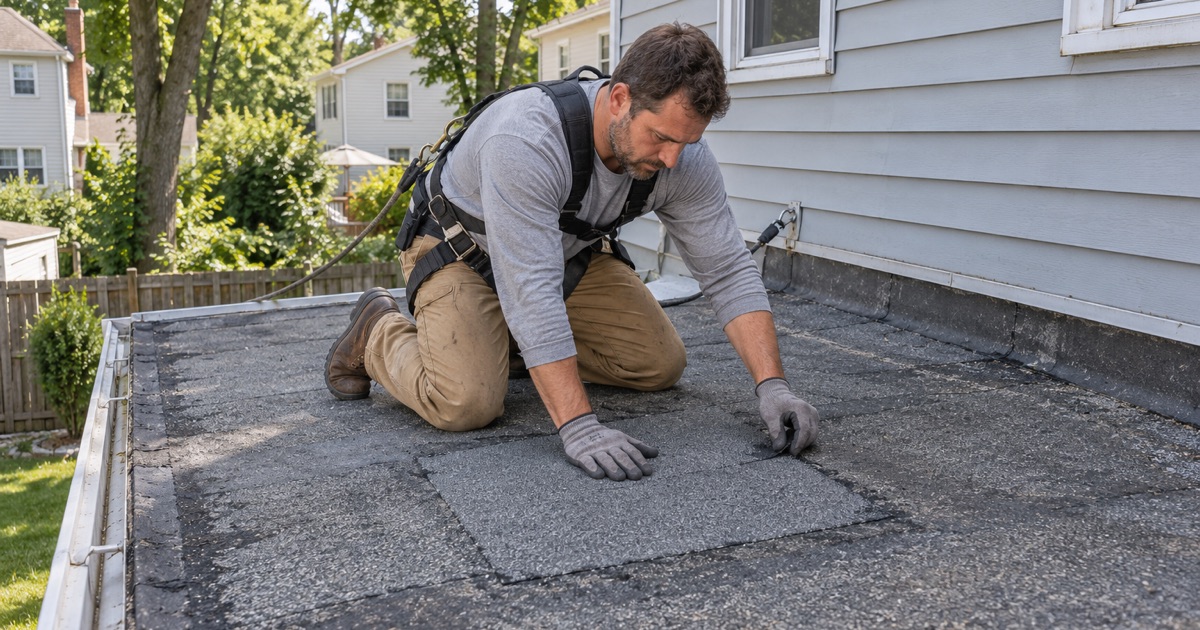
Modified bitumen is a rolled roofing applied in layers, often by torch, with a granulated cap sheet on top. It is common on porches and additions and stands up well to foot traffic. Over time it develops blisters, cracks in the cap sheet and open laps where the rolls overlap.
We repair it with compatible modified bitumen material, cutting out blisters and patching damaged areas so the new material bonds properly. Torch work follows fire-safe practices, including watching the area after the work is finished.
EPDM Rubber
EPDM is a black rubber membrane installed in large sheets, with seams joined by primed tape or adhesive. It is flexible and durable but can shrink with age, pulling away from walls and edges, and its seams can lose adhesion.
Repairs use EPDM primer, seam tape and cover strips designed for the membrane. Using the wrong products, such as general roofing cement, can damage the rubber, so we match the repair to the system.
TPO and PVC
TPO and PVC are single-ply membranes, usually white or light gray, with seams joined by heat welding. They reflect sunlight well and are watertight at properly welded seams. Problems usually show up as split seams, punctures and loose flashing at edges.
We repair these membranes with heat-welded patches of the same material, which fuse into the existing roof. Adhesive patches do not bond reliably to TPO or PVC, so we do not use them for permanent repairs.
Common Flat Roof Problems
Ponding Water
Water that stands on a flat roof for days after rain ages the membrane faster and finds every weak seam. Clogged drains or gutters, a deck that has sagged and insulation that has compressed are the usual causes.
We clear the drainage, replace soft or wet sections and, where possible, add tapered material so water moves toward the outlets. On roofs under trees, keeping the edge and drains clear of leaves is often half the battle.
Blisters, Splits and Punctures
Blisters form when moisture or air trapped under the membrane expands in the sun. Splits appear where the membrane has aged or been stressed by movement, and punctures come from foot traffic, dropped tools and falling branches.
We cut out and patch blisters, repair splits and seal punctures with the correct material for the membrane. If damage is widespread, we look for the underlying cause rather than patching the same areas repeatedly.
Wall, Edge and Penetration Flashing
Where a flat roof meets a house wall, the membrane must turn up the wall and be covered by flashing that keeps water from getting behind it. Roof edges need metal that holds the membrane down and directs water into the gutter. Pipes and vents through the roof need their own flashing boots.
These details are where most flat roof leaks begin. We rebuild failed wall terminations, refasten or replace edge metal and reflash penetrations to the membrane manufacturer’s details.
Flat Roofs on Houses
Porches and Additions
Porch roofs and rear additions often have just enough slope to drain and not enough for shingles. Their joint with the main house wall is the most common leak point, especially where the siding above was installed over the roof flashing incorrectly.
We repair the membrane and the wall joint together, so water running down the siding stays outside the roof. If a porch roof is better suited to standing seam metal, we can discuss that option too.
Dormers and Split-Level Roof Sections
Shed dormers and the lower roofs on some split-levels carry low-slope sections that tie into steeper shingled roofs. The transitions between the two are tricky, and leaks often start right at the change in pitch.
We make sure the membrane extends far enough under the shingles above and that the flashing at the transition directs water onto the low-slope roof. A well-detailed transition keeps both roofs working as one.
Garage and Breezeway Roofs
Attached garages and breezeways often have flat roofs that get little attention until they leak. Because no one walks up there, problems such as clogged scuppers or loose edge metal can go unnoticed for a long time.
We inspect and repair these roofs along with any related gutter or drainage work. If you are planning a roof replacement on the main house, it is a good time to address the low-slope sections as well.
Repair or Replace
Checking for Wet Insulation
A flat roof can look intact on top while insulation underneath is soaked from a slow leak. Wet insulation loses its value and can damage the deck. We probe suspect areas to find out how far the water has spread.
If wet areas are limited, we replace them with the repair. If they are extensive, a full replacement is usually the better value, and we explain why.
- 20+ Years in Roofing
- Line-Item Written Estimates
- Same-Day Storm Tarping