Wayne Quality Roofing has spent more than 20 years on roofing in Hanover, and a growing share of the calls from this township come from houses young enough that a roofer may not be the first party an owner should phone. A leak on a recently built home can be a defect the builder is obligated to correct, and knowing that before a crew climbs a ladder saves the owner money and confusion.
So on a newer house our first questions are how old the roof is and what the weather was doing when the leak started. A drip after an ordinary shower points one way, and a drip after a nor’easter points another. We still go into the attic as well as onto the roof on every leak call, because the stain on a ceiling is rarely where water actually gets in.
Older Hanover homes get the roofing work you would expect from us: an honest answer on whether a roof can be repaired before replacement is ever raised, written scopes broken into line items, and flashing renewed with the roof. This page spends most of its time on the newer end of the township’s housing, where New Jersey’s new home warranty rules decide who acts first.
New Homes in Whippany and Cedar Knolls
What the Census Counts
Hanover Township is a Morris County township of 14,677 people at the 2020 census, and it takes in the unincorporated communities of Whippany and Cedar Knolls. Much of its housing is decades old, but the 2024 American Community Survey counts 560 homes built since 2010: 501 from 2010 through 2019 and 59 since 2020. Those are roofs young enough that builder obligations can still matter.
Build era alone is not the story, though. A house finished ten years ago is far past any first-year coverage, and its roof is ordinary roofing work. What makes Hanover different is that it keeps adding for-sale homes, so every year a fresh group of owners moves into the short window where the warranty rules speak before any contractor does.
The Grove and Earlier Communities
Lennar announced The Grove during September 2024 as 60 two- and three-story townhomes in the Whippany section, close to Route 10, and its community page lists the site at 90 Mt Pleasant Avenue. Years earlier, Whippany Crossing launched sales of 24 two-story homes at Park Avenue and Whippany Road during August 2017, built by a partnership of High Point Development and CantorBuild.
We have not read the warranty plan any of these builders uses, or any association document for these communities, so we cannot tell an owner what their own paperwork says. What we can do is explain how the state rule treats roofs, and confirm who holds the roof in a townhouse community against the association’s documents before we write any estimate.
What Is Planned at 85 Whippany Road
The next wave is still on paper. JMF Properties closed during August 2026 on 86 acres at 85 Whippany Road, off Route 10, with plans for 320 for-sale townhomes alongside rental apartments and a hotel. The company expects to begin delivering pad sites for the townhomes during spring 2027, so those homes are still ahead, and their first owners will start out under the same state rules as everyone before them.
Looking for roofing closer to Little Ferry? See Little Ferry Roofing.
What the State New Home Warranty Says About Roofs
Three Coverage Periods
New Jersey’s New Home Warranty and Builders’ Registration regulations, at N.J.A.C. 5:25, set three clocks. A new home must be free of performance-standard defects for one year from the warranty date, of mechanical and electrical system defects for two years, and of major structural defects for 10 years.
Roof leaks and shingle problems sit under the performance standards, which makes the one-year clock the one that matters most for a roof. The regulation text we read does not define the warranty date, and we have not read the claim procedure or its deadlines. An owner should get those details from their own warranty documents and the builder, not from a roofing contractor.
The Roofing Standard in Plain Words
The roofing section is unusually specific. It says roof or flashing leaks that occur under normal weather conditions are a deficiency, and the builder is to correct any such leak once it is verified. It also treats shingles that lift or curl during the first year of coverage, or that tear loose in normal weather, as a deficiency the builder is to repair or replace.
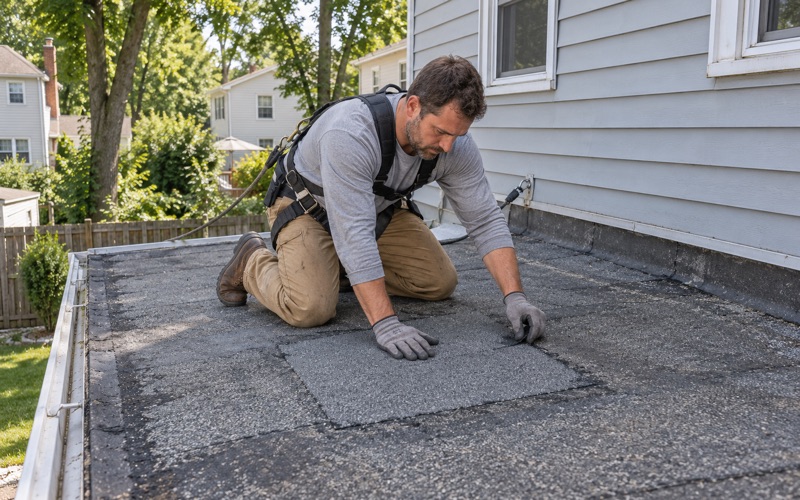
The same standard covers excessive ponding that makes a built-up roof leak, which matters on the low-slope sections some attached designs carry, and a related item treats leaking gutters and downspouts as a deficiency. None of this tells an owner how a particular builder will respond. It tells them which kinds of roof trouble the state rule names.
Why We Raise It Before We Quote
We bring the rule up because an owner who pays us to fix a first-year leak may be spending money on something the regulation assigned to someone else. Saying so before any estimate is the same habit as telling an owner a roof can be repaired before talking about replacement. What to do with that information is always the owner’s decision.
First-Year Leaks, Lifted Shingles and Severe Weather
A Leak on a Calm Day
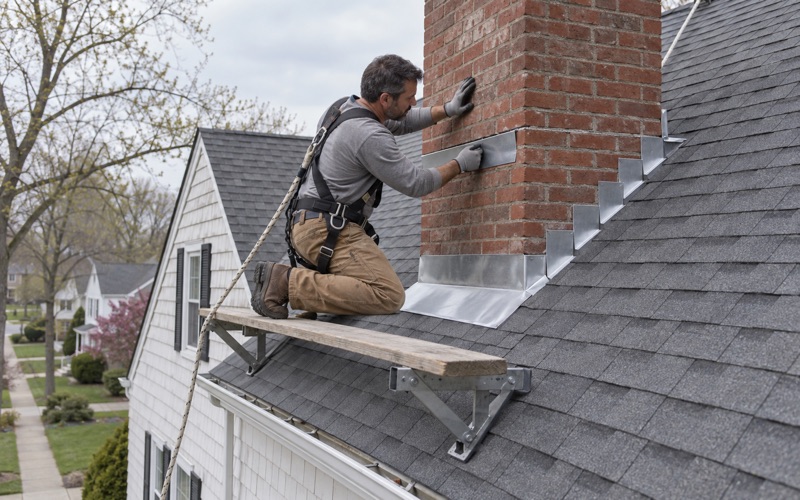
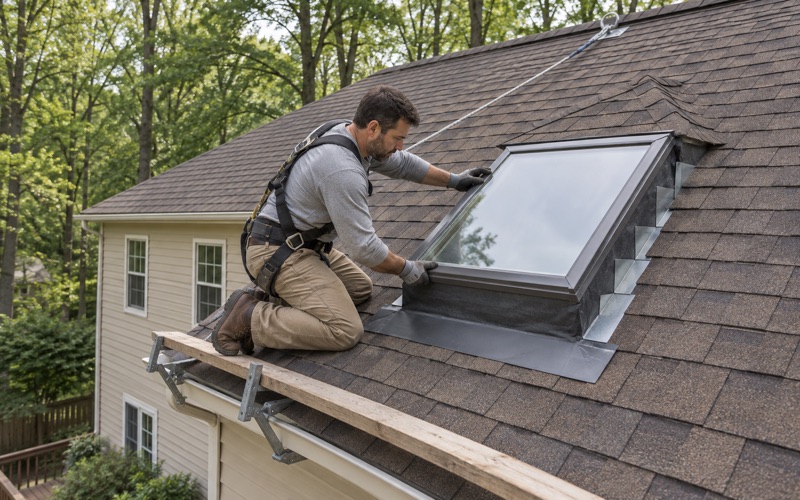
On a townhouse in its first year, a drip that shows up after an ordinary rain is the pattern the rule describes. Our attic inspection still earns its keep here: we can show where water is entering, whether at a pipe boot, a valley, step flashing along a sidewall or the drip edge, and photograph each point. That record belongs to the owner.
We do not file or argue warranty claims for anyone, and we do not predict what a builder will decide. Many owners take our findings into the builder’s own process first, which is a sensible choice in the first year. If an owner wants us to make the repair anyway, we write it up like any other job, with each item on its own line.
Shingles That Lift or Curl
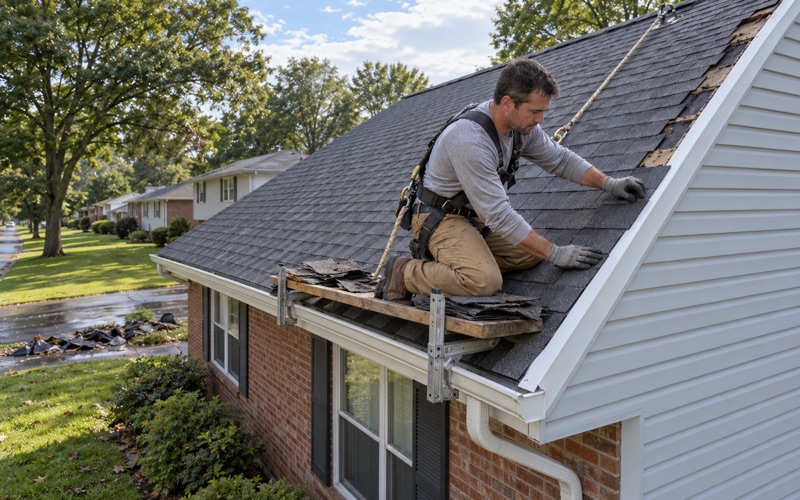
Architectural shingles on a new roof are meant to seal down once warm weather arrives. When tabs lift or curl in the first year, or tear loose in a normal storm, the state standard names that a deficiency for the builder to repair or replace. We can identify which courses are affected and note whether the pattern looks like a sealing problem or a nailing problem.
Lifted shingles are easy to ignore because nothing drips at first. The trouble is that wind gets under a loose tab and peels more of the course, and water then finds the nail line. Documenting the condition early keeps the timeline clear for the owner, whoever ends up making the fix.
When Severe Weather Changes the Picture
The roofing standard carves out leaks caused by severe weather conditions, naming ice and snow build-up, high winds and driven rains, and points to the warranty exclusions. We have not read the text of those exclusions, so we describe the line only as the roofing standard draws it. A leak that starts after an ice dam or a hard windstorm is the kind it sets aside.
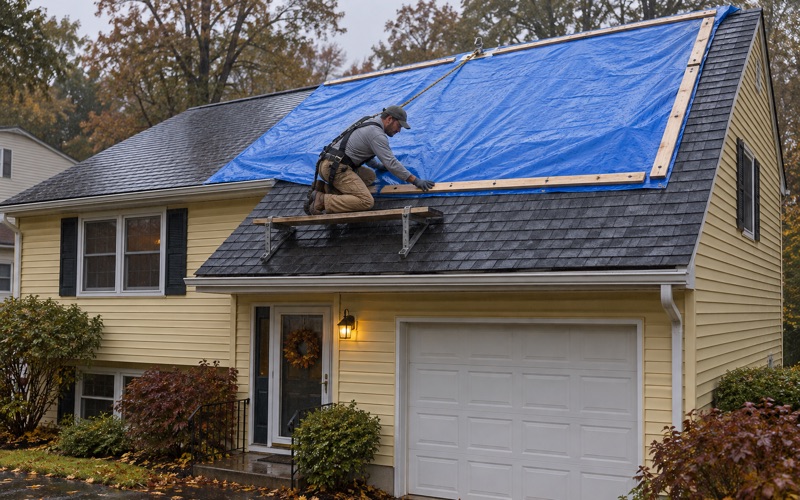
That means storm damage on a new Hanover roof usually becomes roofing work, often alongside the owner’s own insurance claim. We photograph the damage and write it up for that claim, meet the adjuster on site when the owner asks, and get tarps or temporary repairs on the same day after a wind storm, with photos taken before anything is moved.
Townhouse Roofs and Associations
Many of Hanover’s newest homes are townhouses, and in an attached community the roof may be held by an association rather than by the individual owner. Because we have read no association document for any Whippany community, we check who holds the roof against the owner’s own documents first. Only then do we write an estimate, so nobody pays for a roof that is someone else’s responsibility.
After the Warranty: The First Repair on a Newer Hanover Roof
When the First Year Ends
Once the first year has passed, a lifted shingle or a calm-day leak no longer falls under the roofing items in the performance standards, and the roof is ordinary roofing work. For most owners of a house built during the 2010s, the first repair is simply a roofing call, and the question becomes who will trace the leak properly and price it honestly.
That first repair is where a roof’s early workmanship shows. On a young roof the common culprits are pipe boots, step flashing where a roof meets a sidewall, a missing kick-out flashing at the base of a wall, and valleys packed with leaves. We trace the leak from the attic before pricing anything, and we tell the owner plainly whether a repair will hold.
Ventilation on a Young Roof
Newer townhouses often have compact attics, and a roof that cannot breathe ages from underneath. On a younger Hanover roof we check the balance between soffit intake and ridge vent, and whether insulation has crept over the soffit openings. Correcting airflow early costs far less than chasing the curled shingles and damp decking that poor ventilation tends to cause later.
Written Scopes and Contracts
When a newer roof needs more than a repair, our written scope lists tear-off, decking, underlayment, flashing, ventilation and gutters as separate lines, so an owner can compare two estimates item by item. Decking found damaged once the old roof is off is photographed and shown to the owner before it is replaced, at the per-sheet price set in the contract.
Our contracts follow New Jersey’s home improvement rules, including the three-day cancellation notice. Step, counter and apron flashing are replaced with the roof rather than reused, and the driveway, yard and gutters are cleaned at the end of each work day, with a magnet sweep for nails. Those habits hold on a Whippany townhouse row just as they do on a 1950s ranch.
Selling a Newer Home
Newer homes change hands too. For a seller, we write a roof condition report that can go straight to the buyer’s inspector, noting what we saw on the roof, the flashing details and anything we found in the attic. It gives both sides the same facts about the roof, so neither one has to guess at its condition during the sale.
- 20+ Years in Roofing
- Line-Item Written Estimates
- Same-Day Storm Tarping