Wayne Quality Roofing handles roofing in Hasbrouck Heights with more than 20 years in the trade behind every repair, replacement and inspection we take on. Most roof calls start the same way: a stain on a bedroom ceiling, a few shingle pieces on the lawn, or an owner who simply wants to know whether last night’s wind did anything. Our job is to give that question a real answer.
Wind is the issue we spend the most time explaining, because it is the one most owners underestimate. A hard gust rarely peels a whole roof away. What it usually does is quieter: it breaks the seal under a row of shingles, bends them back, and lets them settle down again looking almost normal. The leak arrives months later, long after the storm is forgotten.
The Teterboro Airport Wind Gauge on the Borough’s Edge
A Weather Station Next Door
Teterboro Airport sits on the eastern border of Hasbrouck Heights, and Wikipedia’s article on the field places it partly in the borough itself, alongside Teterboro and Moonachie. The Port Authority of New York and New Jersey owns it. Like most airports, it runs an automated weather station that reports wind and peak gusts around the clock, and that record is the nearest measured wind reading to any roof here.
That matters because most conversations about storm damage run on impressions. One owner remembers the house shaking, a neighbor remembers a branch coming down, and nobody can say how hard the wind actually blew. A station on the borough’s edge turns that into a dated number. It cannot say what happened on a given street, but it shows how often the area gets wind strong enough to work at shingles.
What Eleven Years of Gusts Show
We read the station’s daily summaries for 2015 through 2025 in the Iowa Environmental Mesonet archive, which keeps the highest gust logged each day. Across those eleven years, Teterboro Airport recorded 32 days with a gust of 50 mph or more. That is close to three hard-wind days a year on average, which is plenty for a roof that has already lost some of its grip.
The archive has gaps. Some days carry no gust value at all, including a stretch in early March 2018, so the list is a ranking of what the station logged rather than a complete history. We treat it that way. The useful takeaway is not any single number but the pattern: strong gusts reach this part of eastern Bergen County several times a year, in every season.
Why the Gauge Matters to an Owner
You do not need to follow weather data to use it. When we inspect after a storm, knowing that the airport logged a strong gust that night tells us where to look first: the windward edges, the ridge and the rakes. It also helps an owner decide whether a check is worth the call, since a night with a logged peak above 50 mph is a reasonable trigger.
What the station cannot do is speak for an individual house. Its exposure on a flat airfield differs from a home set well above the field’s elevation, and wind behaves differently around trees and neighboring roofs. We use the reading as context, then let the shingles themselves tell us what happened.
Looking for roofing closer to Wood-Ridge? See Roofing Services in Wood-Ridge.
Christmas Morning 2020 and the Summer Storms
A 67 mph Gust at 1:30 a.m.
The highest daily gust in that eleven-year archive came on Christmas morning. The raw observation remarks from Teterboro Airport include the entry PK WND 16058/0630, meaning a peak wind of 58 knots from 160 degrees, south-southeast, at 0630 universal time. Converted, that is about 67 mph at 1:30 a.m. on December 25, 2020.
The routine reports that morning showed gust groups topping out at 43 knots, so the 58-knot figure came from the peak-wind remark rather than the regular readout. Other peak entries between 44 and 51 knots came before and after it. For a roof, that means repeated hard pushes across a long night, not one isolated burst.
Bergen County Among the Hardest Hit
The Associated Press, in coverage carried by FOX 5 NY, described winds gusting past 60 mph in some areas during those early hours and named Bergen County one of the hardest-hit areas, with more than 7,370 PSE&G customers affected. The coverage spoke of downed trees across northern New Jersey. It did not describe roof damage in the county, and we found no report specific to Hasbrouck Heights for that night.
We point this out because it is the honest way to use the storm. A strong, measured gust near the borough tells us roofs were stressed; it does not tell us any particular roof failed. Damage from a night like that often stays hidden, which is why a check months later can still find it.
Summer Thunderstorms Bring Hard Wind Too
Winter storms are not the whole story. Of the 32 days at 50 mph or more, 13 fell between May and September, when summer thunderstorms push short, violent gusts ahead of the rain. The archive’s next-highest days include 57 knots on September 8, 2023, about 55.6 knots on May 29, 2015, and 55 knots on June 26, 2024.
A thunderstorm gust may last only seconds, and it often arrives with little warning and heavy rain right behind it. If a tab lifts, the water arriving a minute later can find the gap at once. We would rather owners treat wind season as the whole year, because a roof that came through a winter storm untouched can still lose tabs in a July squall.
What a Strong Gust Does to a 1940s or 1950s Roof
Houses of the Postwar Boom
Hasbrouck Heights is a borough of detached homes, and most of them are old. The American Community Survey 2024 five-year estimates show 45.7 percent of housing units built between 1940 and 1959, and 64.9 percent of homes are one-unit detached houses. Many roofs here sit on decks and framing that have already carried several coverings.
Age does not make a roof weak by itself, but it shapes what we find once we look closely. Older decks may carry board sheathing, earlier layers or patched sections from past repairs, and attic ventilation on houses of that era was often an afterthought. Those details affect how well shingles stay put when the wind picks up.
Lifted and Unsealed Tabs
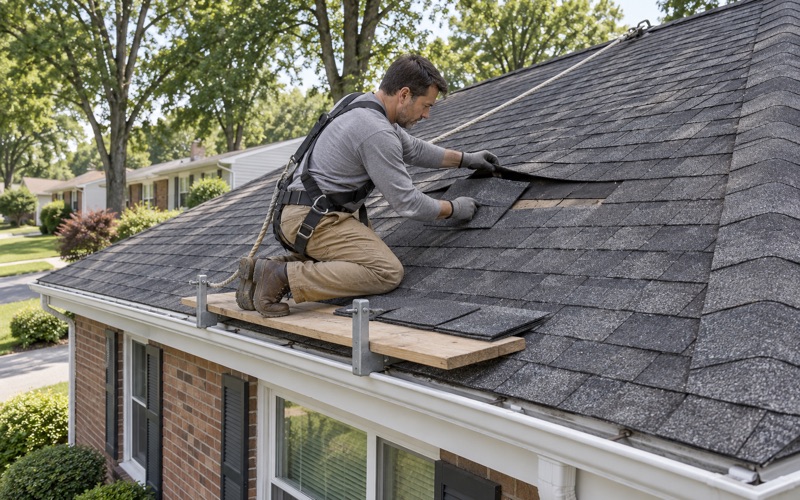
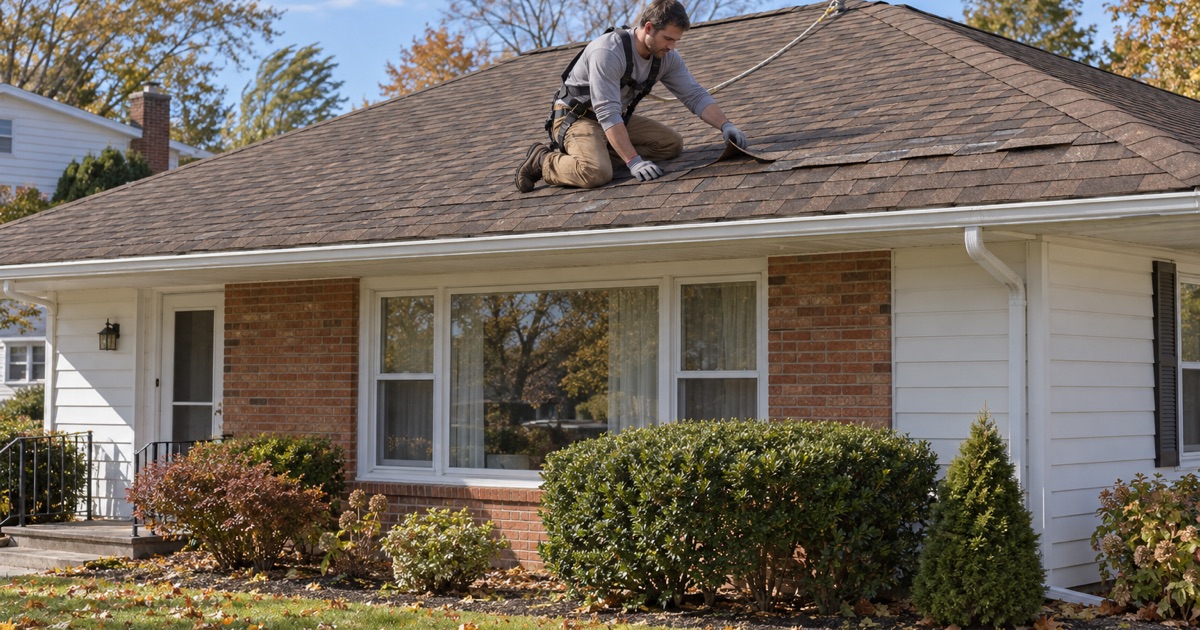
Modern asphalt shingles are held down by nails and by a strip of sealant that bonds each course to the one below. A hard gust can break that bond. The tab lifts, flutters and often drops back into place, so from the ground the roof looks fine even though the shingle is now loose and free to lift again in the next storm.
Unsealed tabs are the most common wind damage on asphalt roofs, and the easiest to miss. Each time a loose tab lifts, it works the nails beneath it and lets wind-driven rain reach the underlayment. Left alone, a few unsealed tabs along an edge can become a missing shingle, then a wet deck, then the ceiling stain that finally prompts the call.
Creased Shingles and Lost Ridge Caps
When a tab bends back far enough, it creases across the shingle. A creased shingle has a weakened line that will not lie flat or seal again, and it usually needs replacing even though nothing has torn off. Creases are hard to spot from below and often show only as a faint horizontal line in low, raking light.
Ridge caps take the worst of a strong blow because they sit at the highest, most exposed point and are fastened through a narrow strip. On older homes, the caps may have been cut from three-tab shingles that have since dried out. Losing even a few ridge caps opens the very top of the roof to rain, and on a ridge vent it can expose the vent opening directly.
Shingle Wind Ratings Are Not Gust Readings
Owners sometimes ask whether a strong gust means their shingles were overmatched. It does not work that way. ASTM D3161 sorts shingles into Class A, D or F using fan test speeds of 60, 90 and 110 mph, but the standard itself says the results do not directly correlate to wind speeds in service.
So a rating on the wrapper is not a promise for a specific storm, and a gust reading is not proof of failure. What tells us whether wind damaged a roof is the roof: loose tabs, creases, missing caps and exposed nails. When we replace a roof, we can talk through higher-rated choices such as ASTM D3161 Class F or ASTM D7158 Class H shingles without pretending a label settles everything.
Checking for Lifted Tabs and Lost Ridge Caps After a Blow
What You Can Check From the Ground
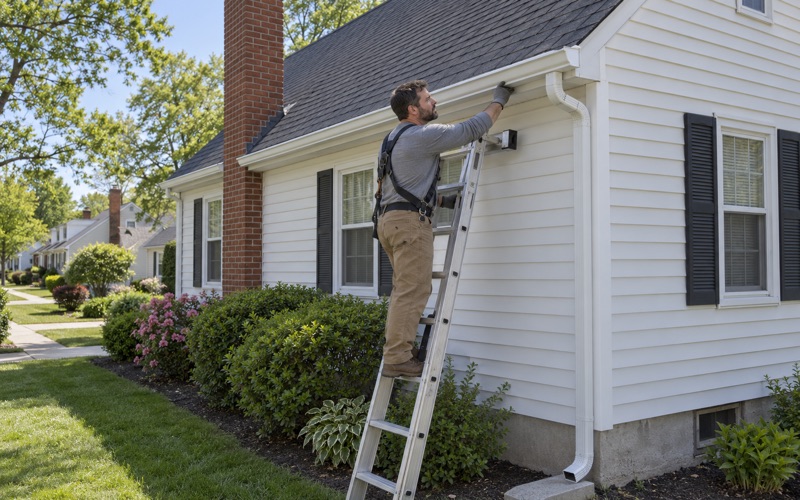
After a strong wind, walk the yard before anything gets mowed or raked. Shingle pieces, granules gathered at downspout outlets and bits of ridge material are worth noting. From the sidewalk, look along the ridge line for gaps and along the edges for shingles sitting at a different angle than their neighbors. Please leave the ladder in the garage.
Seeing nothing does not mean the roof is clean. Unsealed tabs and creases rarely show from below. If the airport logged a strong gust and your roof has a few years on it, a closer look costs far less than a ceiling repair later.
Our Inspection Covers Roof and Attic
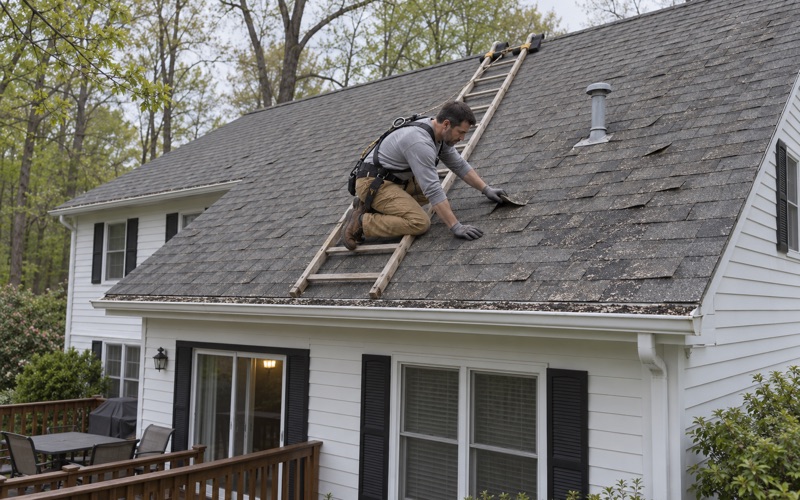
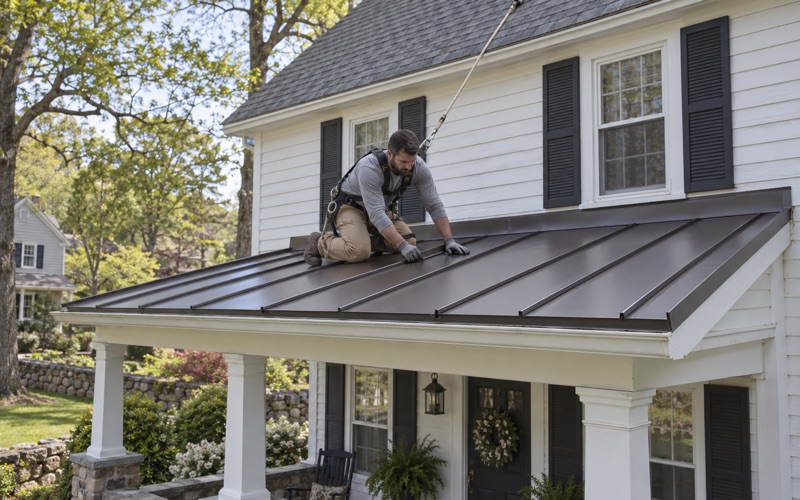
When we come out, we check the roof surface, lifting tabs by hand along the edges and ridge to see whether the seal still holds. We also go into the attic, because wind-driven water often shows up there first as a stained board, a damp nail tip or a dark spot near the ridge. Tracing the water from inside tells us where it actually gets in.
That attic visit also lets us look at ventilation and deck condition, which matter on a house from the postwar years. A roof that cannot breathe ages from underneath, and a deck that has been wet before will not hold nails as well. We note what we find before we price anything.
Tarps, Photos and the Adjuster
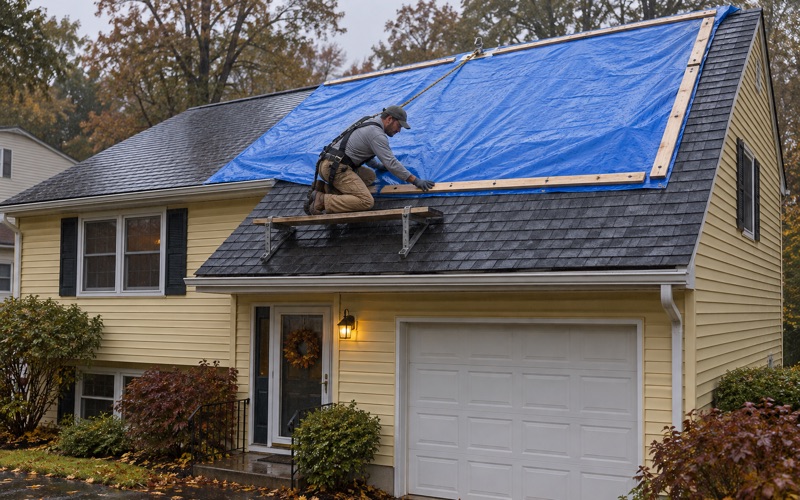
If a storm has opened the roof, we put a tarp or temporary repair on the same day and photograph the damage before anything is moved. Those photos and our written notes are prepared for the owner to use with their own insurance claim. If you ask, our crew will meet the adjuster at the house and walk the roof with them.
Whether a policy pays for any of it is the insurer’s decision, and the claim itself stays between the owner and the insurer. What we can do is speak with the adjuster about the roof and make sure the lifted tabs, creases and missing ridge caps are seen clearly, with dated photos that show the roof as it was found.
A Straight Answer on Repair or Replacement
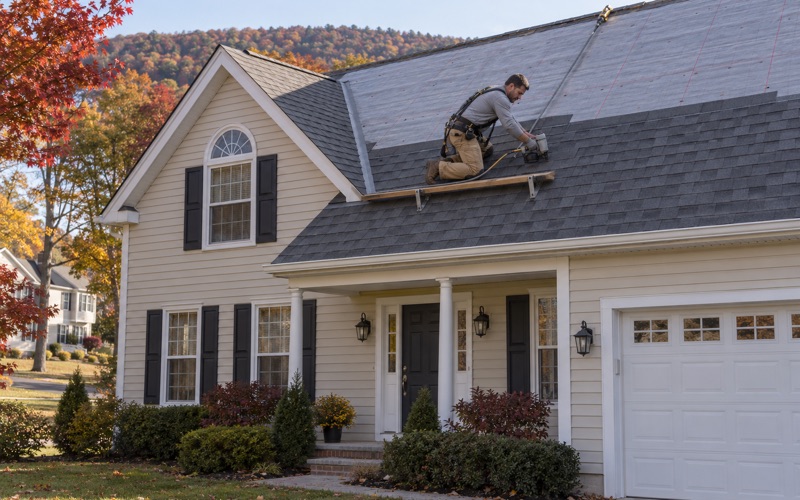
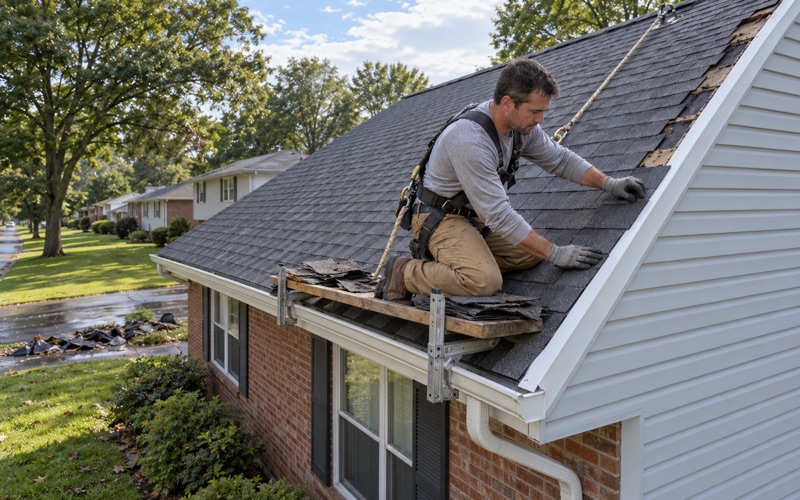
Most wind damage is repairable. A few resealed or replaced tabs and a new run of ridge caps can return a sound roof to service, and we say so before replacement ever comes up. When the damage is widespread or the shingles are too brittle to hold a repair, we explain why and show you what we found.
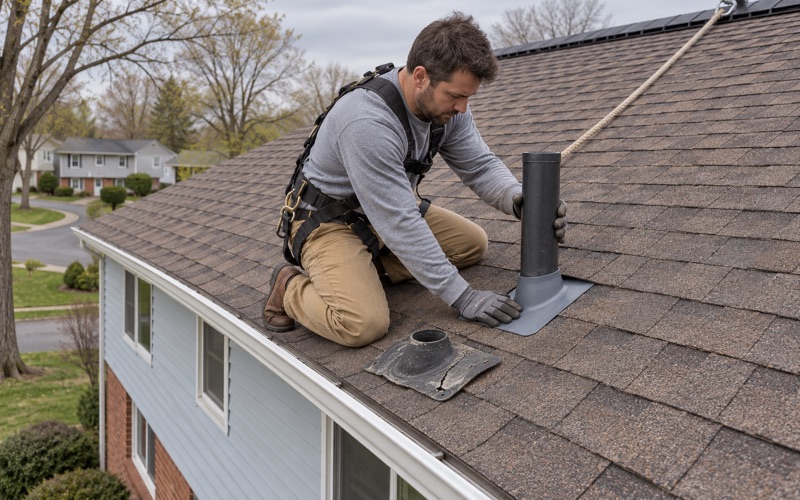
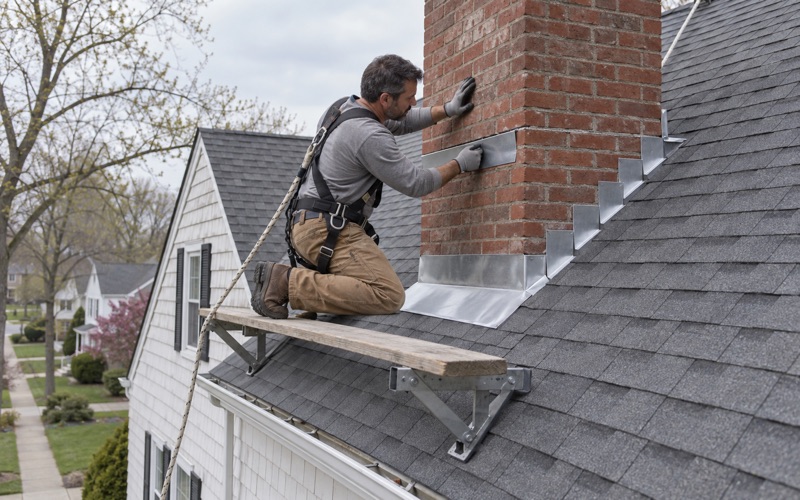
If replacement is the right call, our written scope lists tear-off, decking, underlayment, flashing, ventilation and gutters as separate lines so you can compare estimates item by item. Damaged decking found under the old roof is photographed and shown to you before it is replaced, at a per-sheet price set in the contract. Step, counter and chimney flashing is replaced with the roof, never reused.
- 20+ Years in Roofing
- Line-Item Written Estimates
- Same-Day Storm Tarping