Wayne Quality Roofing brings more than 20 years of roofing in Kinnelon homes and the rest of our service area to every job, and here that work is shaped by trees. We repair and replace asphalt, slate, metal and low-slope roofs, and every leak call includes a trip into the attic as well as onto the roof. Water gets traced to the point where it actually enters before we put a number on anything.
A homeowner who calls us gets a straight answer first: can this roof be repaired? Replacement comes up only when the honest answer is no. When a new roof is the right call, our written scope breaks out tear-off, decking, underlayment, flashing, ventilation and gutters as separate lines, so a second estimate can be laid beside ours and compared item by item.
What sets a roof here apart has less to do with rain and more to do with what falls from the canopy and what could drift in on the wind. Leaves, needles, overhanging limbs and shaded slopes are named in our estimates rather than discovered mid-job. Below, we explain why the borough’s own hazard planning points at the roof edge and the gutter line, and what we do about it.
Kinnelon’s wildfire fuel hazard, by the county’s count
What the hazard annex measured
Morris County’s 2020 hazard mitigation plan update gives each municipality its own annex, and Kinnelon’s risk table reads differently from most. It counts 95 residents and 39 buildings inside wildfire fuel hazard areas rated high, very high or extreme, carrying $34,802,554 of exposure. The same table places 0 people and 0 buildings inside the 100-year flood area.
That is a county estimate with moderate certainty, not a survey of any one street, and the annex still ranks the borough’s overall wildfire hazard as low. Even so, when a planning document finds structures exposed to fire and none exposed to the mapped flood, it tells a roofer which part of the house deserves a closer look first: the edges, openings and gutters where debris and embers collect.
Why that building count matters on a roof
The annex does not identify the 39 buildings by address, and we will not guess which homes they are. What the figure does establish is that some houses here sit close enough to continuous forest fuel for the county to tally them. For any home on a heavily wooded parcel, we treat the roof as part of that same conversation rather than a separate one.
In practice, our inspection notes go beyond shingle wear. We record how close branches hang over the roof, how much debris sits in the valleys and gutters, and whether eave and soffit openings are screened. Those observations land in the written report next to the usual findings on flashing, decking and attic ventilation, so the owner sees the whole picture at once.
No Firewise listing, and a plan held in the EOP
The annex records that Kinnelon has no Firewise community classification, and no Morris County community appeared on the state’s February 2020 list of 27 Firewise communities. The borough’s wildfire planning entry says protection is covered by its emergency operations plan, backed by mutual aid agreements with adjacent municipalities and the NJ Forest Service.
None of that suggests neglect. It does mean much of the preparation on a private lot falls to the owner, and the roof is one of the few parts of that preparation that gets rebuilt only once every couple of decades. A replacement is the natural moment to make choices that a homeowner would otherwise have to retrofit later at greater cost.
Looking for roofing closer to Waldwick? See Roofing Services in Waldwick.
Wooded lots where fire trucks bring their own water
The vulnerability the borough listed itself
Among the additional vulnerabilities in Kinnelon’s annex is a blunt line about water: drought can affect supply, there is a lack of public water, and emergency services arrive on scene with water but are limited. A separate entry notes the borough sits 97.7 percent within the Highlands Preservation Zone, which the annex ties to having no central utilities.
The annex does not say which neighborhoods are affected, and we make no claim about any particular street or hydrant. The planning point is broader than that. Where firefighters carry a finite supply to the scene, the house that never ignites is the one that asks the least of them, and a roof that gives embers nowhere to settle is part of that.
Smoke Rise, Fayson Lakes and long wooded drives
Housing here is overwhelmingly detached and owner-occupied, from the lake neighborhoods of Smoke Rise and Fayson Lakes to houses set back on long drives under mature trees. Construction is spread from the 1950s through the 2000s, with the 1990s the busiest decade, so many roofs have already been replaced once or are coming due for it.
That mix shapes our scheduling as much as the roof itself. A long, narrow driveway limits where a dumpster can sit, and a canopy that shades the north slope keeps moss and debris on it longer. We walk the property before quoting, so staging, tarping and the end-of-day cleanup are planned rather than improvised on the first morning.
What a roof can do when water is short
A roof cannot add water to a fire scene, but it can avoid handing embers a place to land and catch. Sound shingles with tight edges, closed ridge and eave details, and gutters without a dry leaf bed are the parts a homeowner actually controls. On a wooded lot with limited water nearby, those details carry more weight than they would on a cleared street with short setbacks.
Embers, roof edges and the first 5 feet
The immediate zone in state guidance
New Jersey’s Forest Fire Service treats the first 5 feet around a house as the zone most vulnerable to embers. Its advice for that zone is plain: clear debris from roofs and gutters, repair loose or missing shingles, and screen eave vents with 1/8-inch metal mesh. Every one of those items sits on the roof we work on or directly beside it.
Embers are the reason the roof matters even when no flame front is close. They travel ahead of a fire, drop into corners and gutters, and smolder in whatever dry material they find. A shingle lifted at its edge or an open gap at the rake gives an ember the same foothold that a pile of leaves along the eave does.
Loose or missing shingles
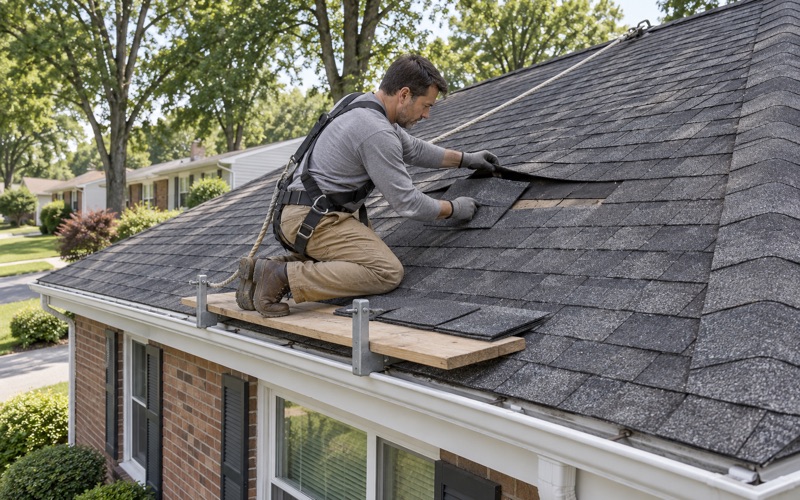
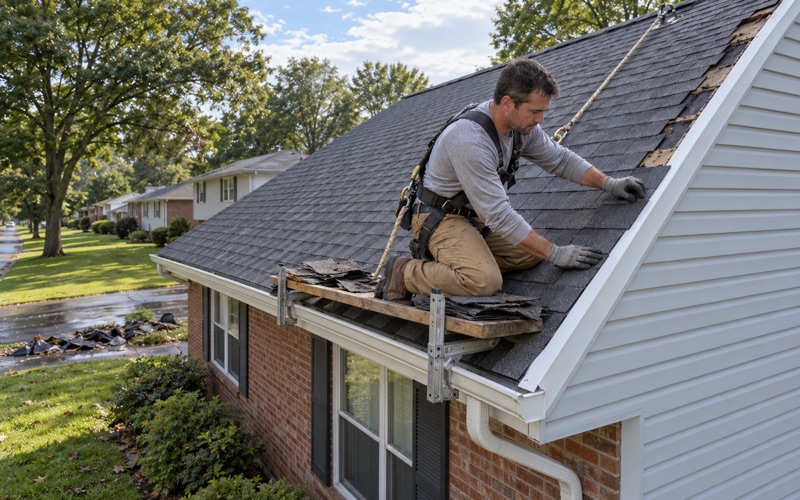
Wind lifts shingles along eaves and rakes first, and on a shaded slope the sealant strips may never have bonded well to begin with. On a repair visit we reseal or replace lifted tabs, replace missing pieces with matched material where it is still available, and check the drip edge so the first course is held tight to the deck.
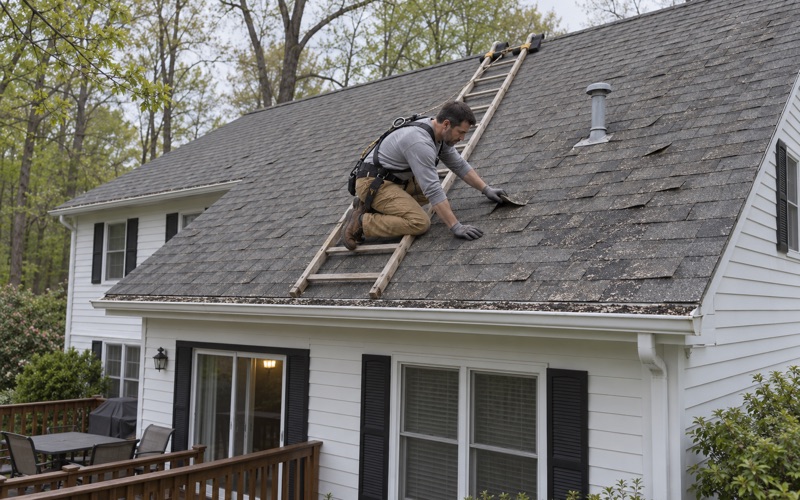
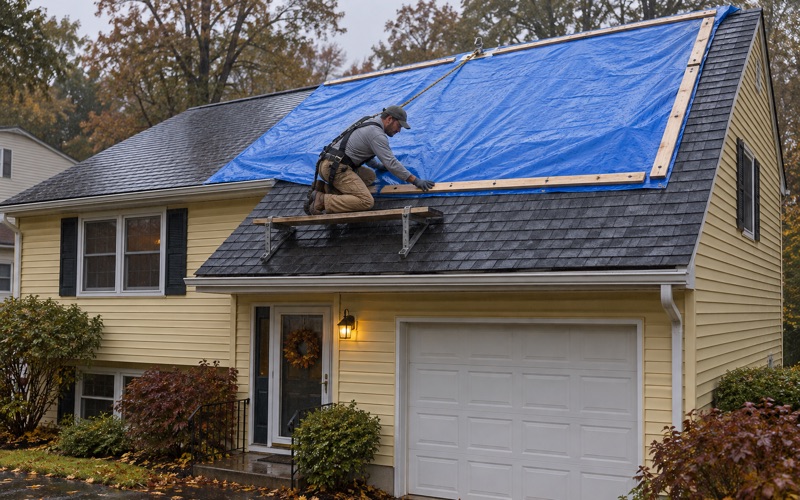
If the problem keeps recurring across a whole slope, we tell you so. A roof that sheds shingles every storm season has usually reached the point where repair spending stops making sense, and we would rather show you that in photos than keep billing for patches. After a wind storm, tarps and temporary repairs go on the same day, with photos taken before anything is moved.
Vents, soffits and the gaps embers find
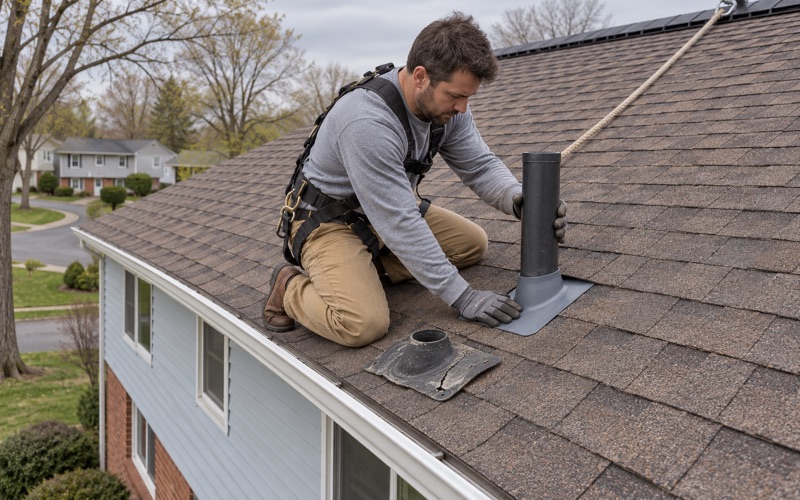
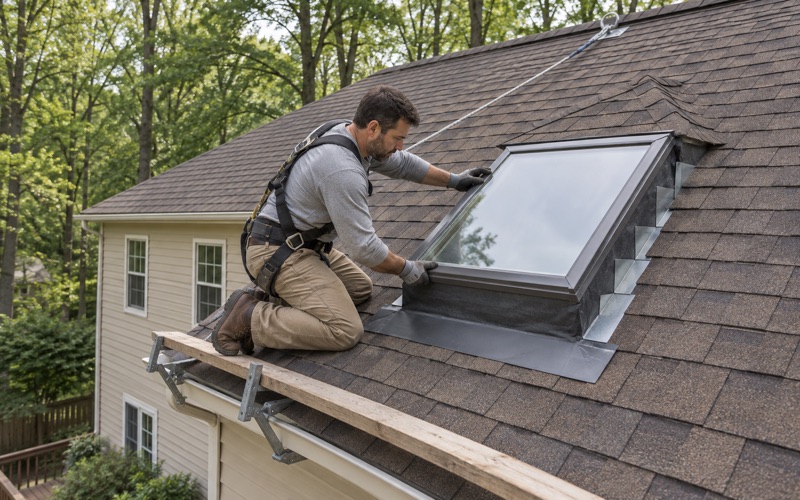
Ridge vents, soffit intakes, gable louvers and pipe boots are all openings, and openings are where embers go. On every replacement we check attic ventilation, because a roof that cannot breathe ages from underneath, and we look at whether the intake openings carry screening fine enough to match the state guidance on mesh size.
Where vent screening is missing, torn or too coarse, we write it into the scope as its own line. That keeps the ventilation decision visible, so it is weighed on its own merits rather than buried in a lump sum, and an owner comparing two bids can see which one actually addresses it.
Leaves in gutters and valleys, and what a re-roof can change
Gutters on a forested lot
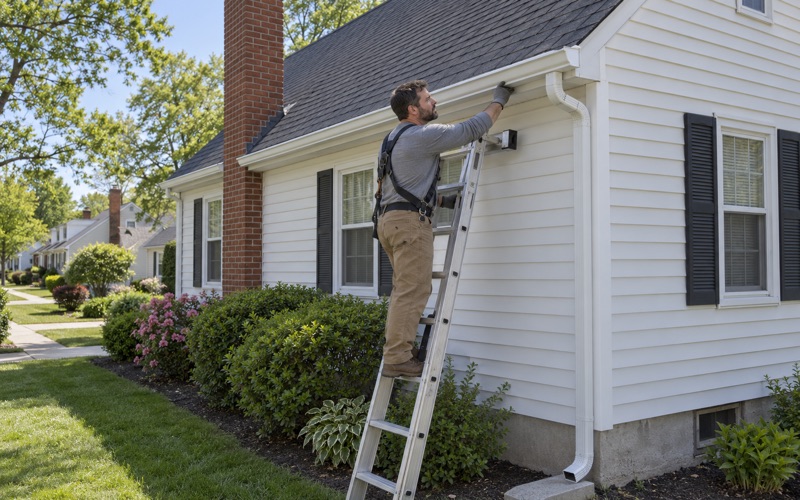
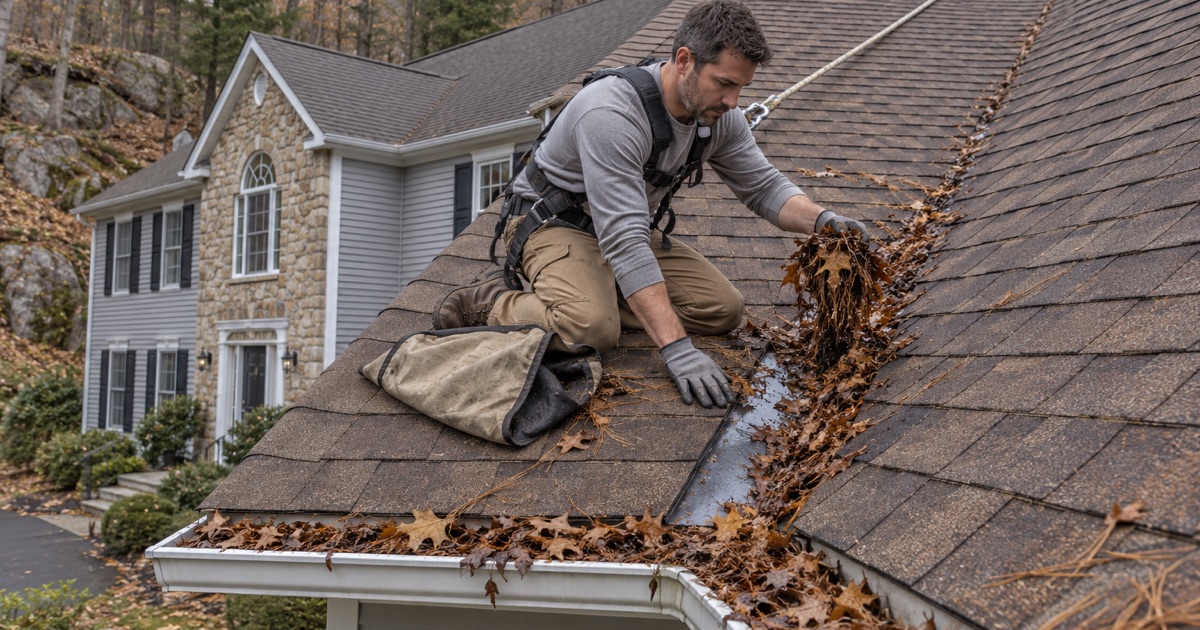
Gutters under a full canopy fill quickly, and a dried leaf bed in a gutter is exactly the kind of debris the state guidance asks owners to clear. Packed gutters also hold water against the fascia and drip edge, which softens wood over time and invites leaks along the eave that show up first as stains on the soffit.
We clean the gutters at the end of every work day on a roofing job, along with a magnet sweep of the driveway and yard for nails. Our scopes list gutters and leaders as a separate line, so if seamless aluminum replacements or a different guard style suits the lot better, that choice is shown clearly instead of folded into the roof price.
Valleys, chimneys and the debris traps between them
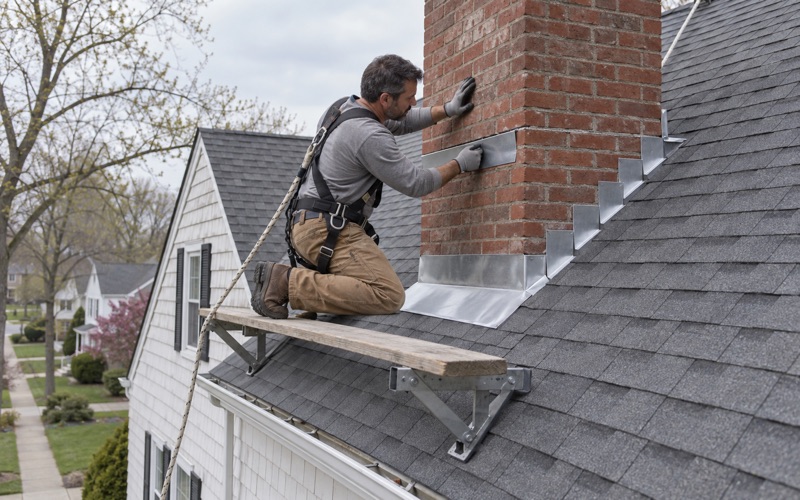
Valleys collect needles and leaves before any other part of the roof, and the uphill side of a chimney traps them too. On replacements we install a self-adhering ice and water barrier meeting ASTM D1970 in the valleys, and where a chimney is wide enough we build a cricket so debris and water are steered around it rather than parked against it.
Step, counter and chimney flashing is replaced with the roof instead of being reused under new material. Old flashing bent back into place is a common source of slow leaks, and on a wooded lot those leaks tend to appear as stained ceilings beneath a valley that has been packed with wet leaves for weeks.
Choosing a covering with ember exposure in mind
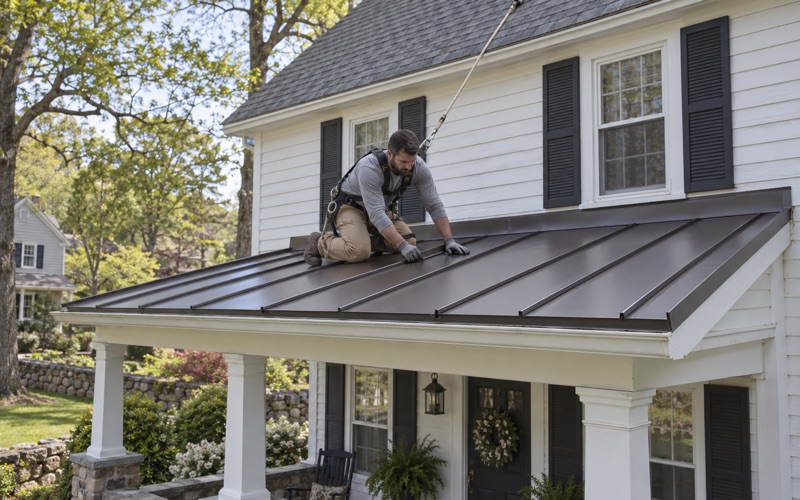
Many architectural asphalt shingles, standing seam metal, natural slate and some slate-look synthetic products carry a Class A fire rating under ASTM E108 or UL 790. We have read no New Jersey rule requiring a fire-rated roof here, so the choice is the owner’s, and we will lay out the rated options side by side with their cost and expected service life.
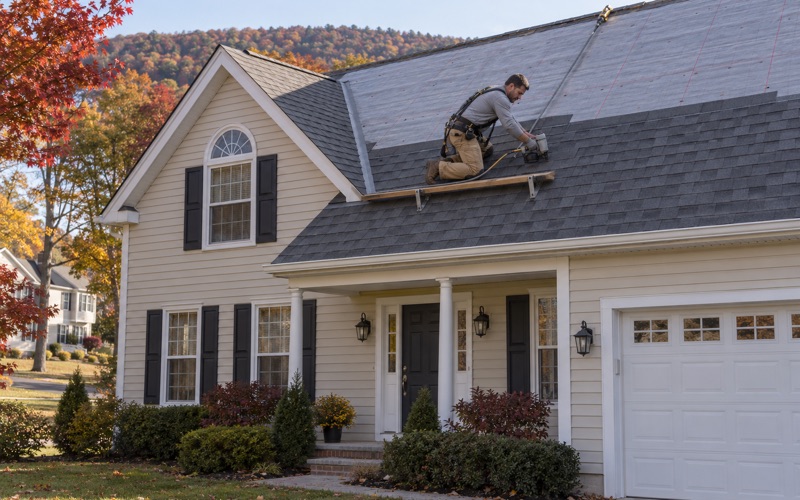
When the old roof comes off, any damaged decking is photographed and shown to you before it is replaced, at a per-sheet price fixed in the contract. Our contracts follow New Jersey’s home improvement rules, including the three-day cancellation notice, and the finished roof leaves a wooded Kinnelon lot with tighter edges, cleaner gutters and fewer places for embers to settle.
- 20+ Years in Roofing
- Line-Item Written Estimates
- Same-Day Storm Tarping