Wayne Quality Roofing brings more than 20 years in business to roofing in Little Falls, and a good share of the calls we take here start with a question about timing rather than shingles. Owners want to know whether a tired roof should be replaced now, later, or alongside some larger project on the house. We give a straight answer on whether a repair will hold before replacement is ever on the table.
That timing question carries more weight on some blocks than on others. A house that has been lifted onto a higher foundation, or one that may be lifted under a flood grant, has a roof with its own schedule. Getting that schedule wrong can leave an owner paying for work a grant was never going to cover, so we plan the roof around the larger job instead of on top of it.
Every estimate we write lists tear-off, decking, underlayment, flashing, ventilation and gutters as separate lines. That is useful on any house and close to essential when one part of a project is paid by a grant and another part by the owner. Each leak call also includes a look in the attic, so the water is traced to where it really enters before anything is priced.
Raised Houses Along the Passaic River and the Grants Behind Them
Little Falls is a Passaic County township named for a waterfall on the Passaic River at a dam near Beattie Mill. The same river has flooded parts of the township often enough that federal money has gone into lifting houses, not only into buying them. A local summary describes the target as a lowest floor above the Base Flood Elevation of the Passaic and/or Peckman Rivers.
What the 2010 report described
NBC New York reported on October 1, 2010 that a neighborhood of dozens of homes a couple of blocks from the Passaic had flooded three times over 11 years. FEMA had already bought and torn down a handful of Little Falls homes. A newly announced grant would let 34 homes get higher foundations, raised about five at a time over the following few years.
The mayor at the time explained the condition attached to that work: no living space on the first floor, so utilities and belongings sit above flood stage. The same report noted that many other homes would not qualify, and it quoted a resident directly on the riverbank who feared being left out of the program altogether.
What the state listed in July 2011
A July 5, 2011 release from the New Jersey Office of Emergency Management lists a Repetitive Flood Claims grant for five elevations in Little Falls Township, at $364,770. It also lists a Severe Repetitive Loss line for 34 Little Falls properties at $6,636,800, plus one Little Falls acquisition inside a basin-wide award that also covered Pompton Lakes and Wayne.
The state release labels the 34-property line as acquisitions, while the 2010 report and a later local summary describe elevations for the same project total. We have not seen a count of how many houses were actually raised or bought, or on which streets. So we treat every house on its own terms rather than guessing at its history.
Why that history changes a roofing call
An owner near the river may live in a house that has already been lifted, one that was considered and passed over, or one that still takes water. Each of those is a different roof conversation, and we ask which one it is before we measure anything or talk about materials.
A house raised under one of these grants also carries a recorded deed notice that flood insurance be maintained for the life of the property. That flood policy is separate from the homeowner’s policy that responds to wind and storm damage on the roof. When a storm hits, we photograph and write up the roof damage for the owner’s own claim and will meet the adjuster on site if asked.
Looking for roofing closer to Wyckoff? See Roofing in Wyckoff.
Why a Roof Does Not Ride Along on an Elevation Grant
The roof is not part of the lift. That is not a rule we have seen written about roofs specifically; it follows from how the state’s 2020 elevation guidebook for homeowners treats everything beyond raising the house itself.
Only elevation costs are eligible
The guidebook says only expenses necessary for elevating the home are eligible, and that elevation work cannot happen before the grant is awarded. A worn roof, however overdue, is not an elevation expense, so it sits outside the grant from the start.
The guidebook also says homeowner extras are carried at 100 percent homeowner expense and that few will be allowed. Its wording is that any and all extras that can wait must wait until the executed grant is complete. A roof that is merely aging can almost always wait, which usually pushes a re-roof past closeout.
Extras are contracted and paid separately
Where the community does let an extra move forward alongside the elevation, the guidebook calls for a separate contract for it before the Notice to Proceed. Any work outside the state’s cost template must be invoiced and paid separately, and homeowners acknowledge they cannot ask for or accept free work from the elevation contractor.
Our written scopes already put each part of a roof job on its own line, which keeps a roofing agreement cleanly apart from an elevation contract if both are open at once. We are not an elevation contractor and are not on any program list, so our work is always its own contract with the owner, priced and invoiced on its own.
Work before the Notice to Proceed
The guidebook is blunt here: any work started before the homeowner receives a Notice to Proceed will be disqualified from the grant program. It also warns that the time from application to award can take almost two years, which is a long stretch to sit under a roof that is starting to fail.
An owner in that waiting period should check with the township before starting anything beyond a repair. We would rather delay a job than start one that puts an owner’s grant at risk, so when an application is pending we ask about it first and set our schedule around the answer.
Timing a Re-Roof Before or After a House Is Lifted
Owners in this position usually have three windows to work with: before any application, while one is pending, or after the grant is closed out. Each window changes what we recommend and how the contract is written.
A roof that cannot wait
If a roof is actively leaking, the first step is the same as on any house: a look from the attic and from the roof, then a straight answer on whether a repair will hold. A sound repair buys time without committing the owner to a full replacement in the middle of a grant process.
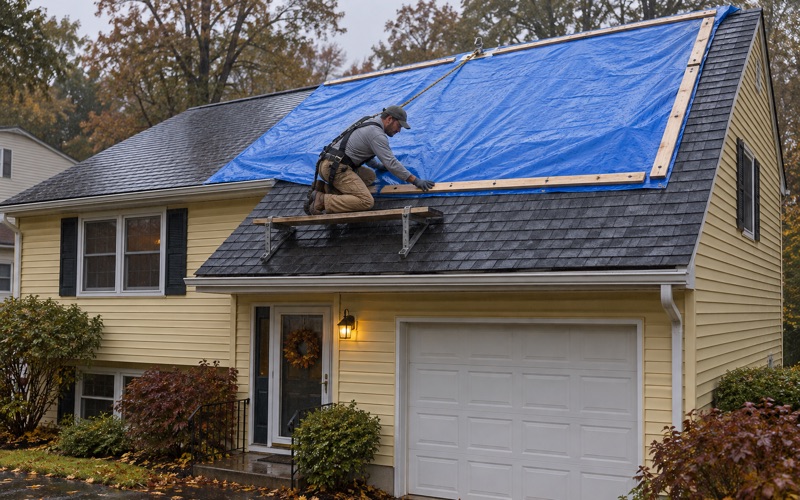
When a wind storm opens a roof, we tarp it the same day and photograph the damage before anything is moved. Temporary protection keeps water out of the living space while the owner checks with the township about anything larger, and the photos stay with the owner for whatever comes next.
Replacing before an application
Some owners decide to replace a failing roof before they ever apply. That keeps the roof out of any grant file entirely, but it also means the house may later be raised with that new roof already on it, so we talk through the plan before materials are chosen.
We check attic ventilation on every replacement either way. A ridge vent only works with enough soffit intake feeding it, and a roof that cannot breathe ages from underneath no matter how high the foundation sits. On older capes and ranches near the river, ice-dam-prone eaves also get an eave membrane, not just new shingles.
Replacing after closeout
Once the elevation is finished and the grant is closed out, the roof becomes ordinary owner work again. For many owners this is the cleanest moment, because nothing we do overlaps an open grant file and the lift crew is long gone from the property.
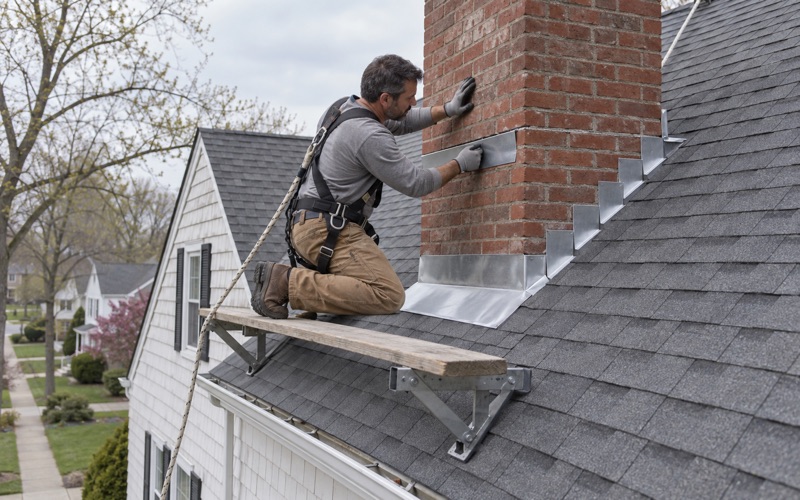
Damaged decking found after tear-off is photographed and shown to the owner before it is replaced, at a per-sheet price set in the contract. Step, counter and chimney flashing is replaced with the roof rather than reused under new material, since old flashing is where a new roof most often leaks first.
Roofing a House That Now Stands Several Feet Higher
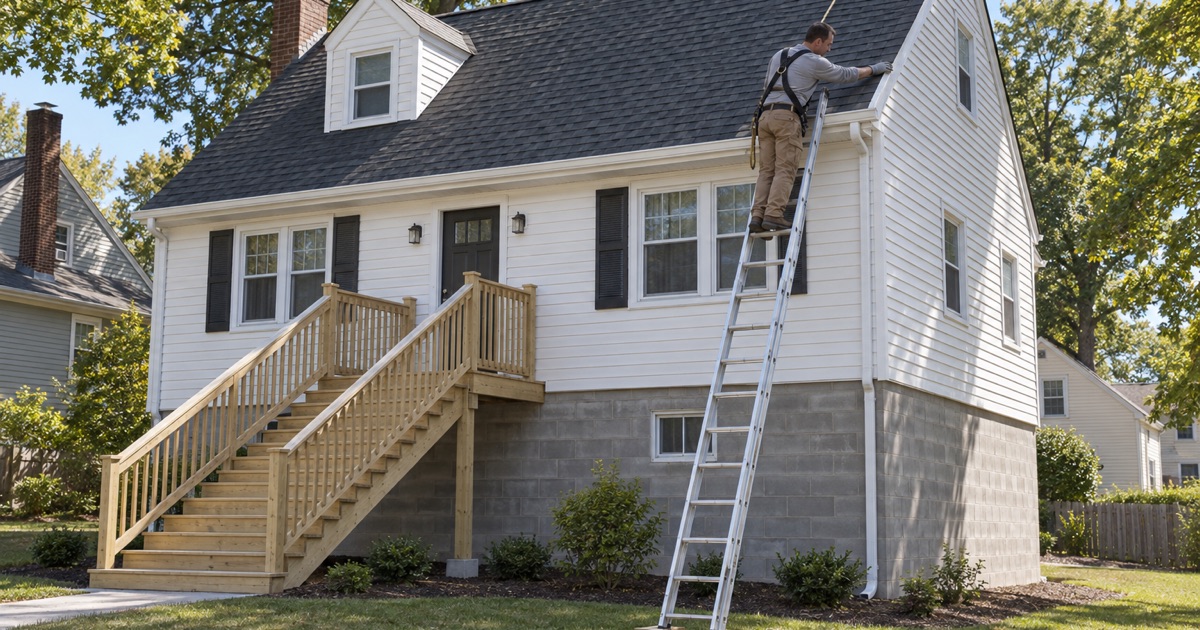
A lifted house puts its eaves well above the roofline of the house next door. That changes the setup and the cleanup more than it changes the shingles, and we plan for it before the crew arrives.
Ladders, staging and fall protection
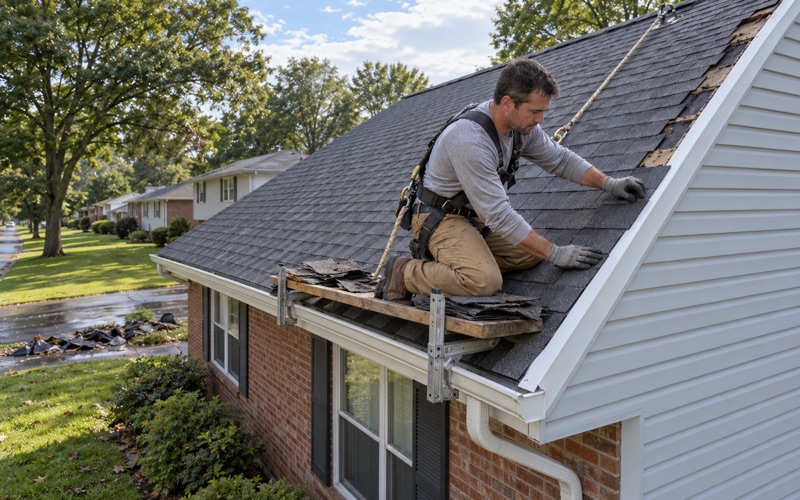
Ladders sized for a standard ranch eave fall short on a raised house, so we plan ladder length, staging and roof anchors for the taller edge ahead of time. OSHA fall protection for residential roofing starts at 6 feet, and on a lifted house nearly every edge sits well past that line.
Debris chutes and the dumpster are placed for the longer drop as well. Tear-off from a higher eave falls farther and scatters wider, so the landing zone, the plantings beneath it and the driveway are covered before the first shingle comes off.
Gutters and leaders on a raised eave
Gutters on a lifted house sit higher and the leaders run longer to reach the ground. We price seamless aluminum gutters and leaders as their own line, so an owner can see what the added height costs rather than finding it folded into a single total.
We also look at where each leader ends. Water dumped at the base of a new foundation wall is the last thing an owner along the Passaic wants, so outlets are directed out and away from the house and the yard grade is part of the conversation.
Cleanup and a record of the work
At the end of each work day the yard, driveway and gutters are cleaned, including a magnet sweep for roofing nails. Our contracts are written to New Jersey’s home improvement rules, including the three-day cancellation notice, and the scope lists every item on its own line.
If the house is ever sold, a written roof condition report gives the buyer’s inspector a clear record of what was done and when. On a raised house with a grant history, that report sits naturally beside the elevation paperwork the owner already keeps.
- 20+ Years in Roofing
- Line-Item Written Estimates
- Same-Day Storm Tarping