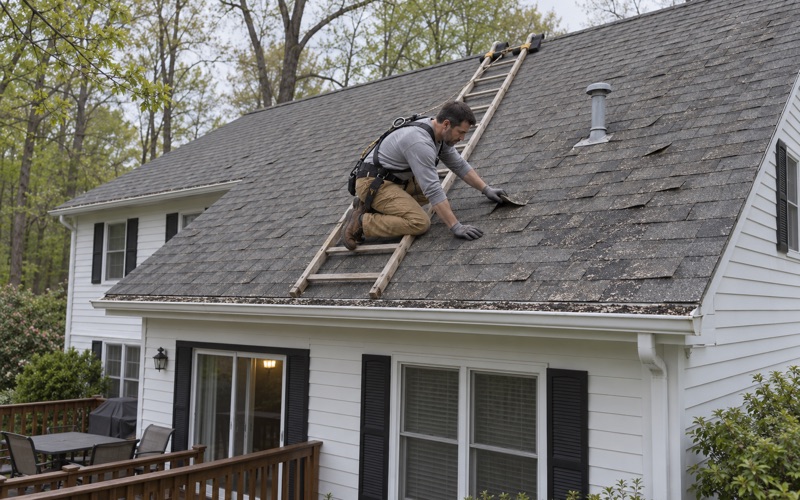
Wayne Quality Roofing has spent more than 20 years on roofing in Pequannock, and the job here starts with a question many roofers skip: does the house sit in the regulated flood hazard area? For a good number of homes the answer changes what approval a re-roof needs, what the estimate has to show, and who at the township looks at the work before the old shingles come off.
That has nothing to do with shingle color or nail patterns. Replacing the roof on a detached house is ordinary maintenance under New Jersey’s construction code, so no construction permit comes into it, yet the township’s flood rules can still call for a floodplain development permit and count the cost of the work. We build that check into the estimate rather than discovering it after the dumpster arrives.
Everything else follows the way we handle any roof. A leak call gets a look in the attic as well as on the shingles, so the water is traced to where it actually enters, and you hear plainly whether a repair will hold before replacement is ever raised. When replacement is the right answer, the scope is written line by line so it can serve the township’s review as well as your own budget.
Pequannock’s August 2025 Flood Map and Chapter 171
A new map and a new chapter, one week apart
FEMA’s current effective flood insurance rate map for the township took effect on August 19, 2025, according to the FEMA Community Status Book. One week earlier, on August 12, 2025, the Township Council adopted Ordinance 2025-09, which created Chapter 171, Flood Damage Prevention, and repealed the flood chapter the township had carried since 1997.
The timing matters to homeowners because both documents changed together. A house that sat outside the mapped flood area before may now be inside it, or the reverse, and the rules that govern work on it are new as well. A roof estimate written from memory of the old map or the old chapter can send a project in the wrong direction from the first day.
Written from the NJDEP model
Chapter 171 follows the New Jersey Department of Environmental Protection’s Riverine Model Code Coordinated Ordinance, the statewide model dated August 23, 2023. Its table of contents tracks that model closely, covering scope and administration, coordination with building codes, minor work, warnings, other laws, violations and penalties, and solid waste disposal in a flood hazard area.
We have read the model text itself, as another township adopted it word for word. Pequannock’s own wording of section 171-26 and its definitions we have not read, so wherever a detail matters to your project, we confirm it with the township rather than assume the local chapter matches the model line for line.
Where the flood area reaches
The Morris County hazard mitigation plan places the township between the foothills of the Waughaw Mountains and the courses of the Pequannock and Pompton Rivers. Its 2020 annex counted 1,164 buildings and 2,831 residents inside the 100-year flood area, and 1,368 buildings inside the 500-year area, for a township of 15,571 people at the 2020 census.
That count is township-wide, spanning Pompton Plains in the north and the Pequannock community in the south. The township holds Community Rating System Class 5 with FEMA, in effect since 2016, a rating that gives flood insurance policyholders a 25 percent premium discount. None of these figures tells you whether a particular house is mapped in, which is why the address check described below comes first.
Looking for roofing closer to Lincoln Park? See Lincoln Park Roofing.
Why a Re-Roof in the Flood Zone Goes to the Floodplain Administrator
Ordinary maintenance, by the state’s definition
New Jersey’s Uniform Construction Code treats replacing the roof covering on a detached one- or two-family house as ordinary maintenance. That is the reason a typical Pequannock re-roof involves no construction permit, and it is also the reason the floodplain development permit is the approval that does apply when the house sits in the regulated flood area.
The two approvals are separate. The floodplain development permit comes from the flood ordinance rather than the construction code, and it exists to track what is being spent on buildings that flood. Owners are sometimes told a re-roof needs no paperwork at all, which holds for the construction code but not necessarily for Chapter 171.
Roofing is named outright
Section 101.5 of the NJDEP model sends improvements the construction code defines as ordinary maintenance and minor work to the floodplain administrator, through the floodplain development permit. Its list reads ‘non-structural replacement-in-kind of windows, doors, cabinets, plumbing fixtures, decks, walls, partitions, new flooring materials, roofing’ and similar work, so roofing sits in the text itself.
Pequannock’s code, as summarized, sends minor work to the floodplain administrator for review against the substantial damage and substantial improvement rules in section 171-26. Taken together, a re-roof on a house in the mapped flood area becomes floodplain administrator business, even though the same job needs no construction permit. That is our reading of the model and the township summary, not a quote from section 171-26.
Who reviews it at the township
The 2020 county annex names a full-time Flood Resilience Officer as the township’s floodplain administrator under the National Flood Insurance Program, working from the municipal offices at 530 Newark-Pompton Turnpike. That office also answers questions about FEMA flood maps, flood insurance and home elevation grants, which makes it the first call for an owner unsure where the house stands.
Construction, engineering, planning and zoning staff worked out of the public works building at 99 Alexander Avenue when that annex was written. Staffing may well have changed since 2020, so we call ahead to confirm who is handling floodplain permits before any application goes forward. A permit question settled by phone before the estimate is signed costs you nothing; one settled after tear-off can stall the job.
How Roof Work Counts Toward Substantial Improvement
Every project joins the running total
Section 103.14 of the model has the floodplain administrator, working with the construction official, include the costs of all ordinary maintenance and minor work performed in the regulated floodplain in substantial improvement and substantial damage calculations. In plain terms, the roof joins any window, siding or interior work on the same house in one combined figure.
That figure decides whether a building has been substantially improved, and crossing that line brings stricter requirements under the ordinance. We have not read how Pequannock’s chapter defines the counting period or the threshold, so we do not quote either one; the floodplain administrator is the person who can answer that for your house.
Market value is the yardstick
Before construction starts, the model has the floodplain administrator estimate the building’s market value, or require the owner to obtain a professional appraisal, and then compare the cost of the proposed work against it. The owner is notified of the result in writing, so the decision arrives on paper rather than as a surprise on the morning the crew shows up.
For an owner planning several projects over the next few years, that comparison is worth understanding before the first one begins. A roof that costs more than expected, because rotted decking or extra layers turned up during tear-off, raises the figure the township weighs against market value. We keep our estimates honest about those possibilities so the number on the application is not the low end of a range.
Valuation stated on the application
The model’s permit application must state the valuation of the proposed work, including the valuation of ordinary maintenance and minor work. That is where our written scope earns its place: tear-off, decking, underlayment, flashing, ventilation and gutters each appear as their own line with their own price. Solar panel removal and reinstall, where a roof carries panels, is listed and priced the same way.
A single lump sum tells a reviewer very little about what is actually being replaced. A line-item scope shows each part of the job, so the valuation on the application matches the contract you sign, and you can set our estimate beside another contractor’s and compare them item by item.
Checking Your Address Before the Roof Crew Is Booked
Confirm the flood map first
We do not guess whether a house is in the flood hazard area, and we do not lean on an older map. Before a start date is set, we check the address with the township against the August 19, 2025 map, and if the house falls inside the regulated area, the floodplain development permit goes on the schedule ahead of tear-off.
Houses outside the flood area move on an ordinary timeline. For those inside it, the permit review sets the earliest start, and we would rather tell you that up front than book a crew for a date the paperwork cannot meet. If a sale is coming up, we can also give you a written roof condition report to hand to the buyer’s inspector.
What the scope covers on an older house
The 1950s is the township’s largest building decade, with 1,711 housing units, about a quarter of the stock, and many older capes, ranches and split-levels have eaves prone to ice dams. Those eaves get a self-adhering ice and water barrier meeting ASTM D1970 and a ventilation check, because a roof that cannot breathe ages from underneath.
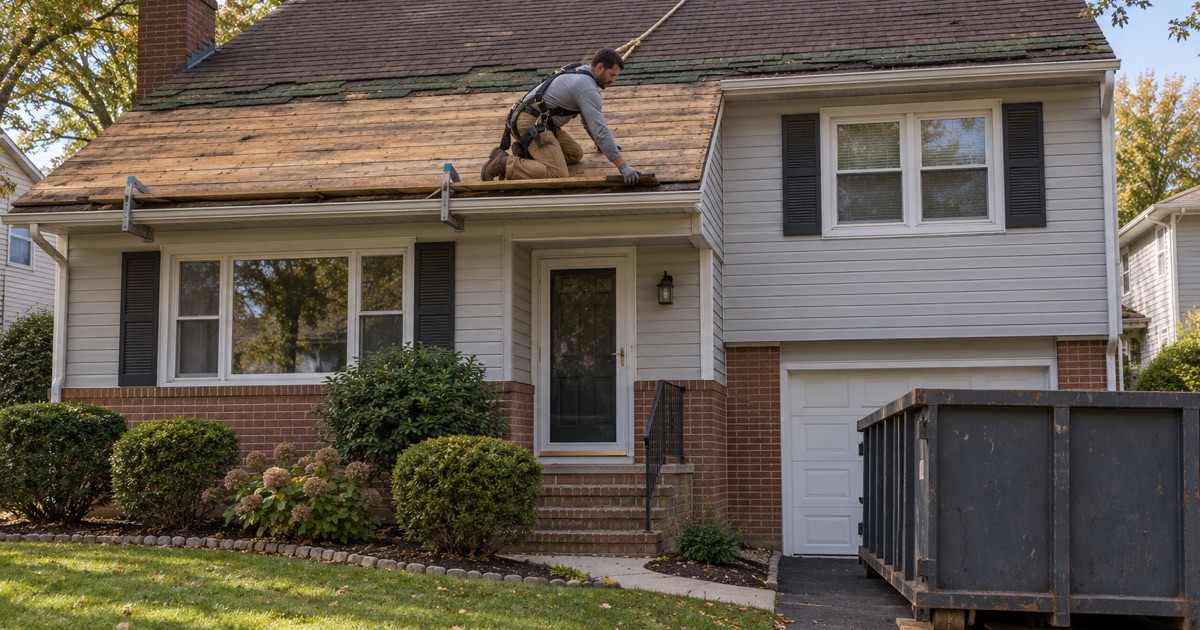
Step, counter and chimney flashing is replaced with the roof rather than reused under new material. Any decking found rotted once the old roof is off is photographed and shown to you before it is replaced, at the per-sheet price written into the contract, so the valuation reported to the township stays accurate. Wooded lots get their overhanging limbs and leaf-packed valleys called out in the estimate as well.
Contracts, cleanup and storm work
Our contracts follow the state’s home improvement rules, including the three-business-day cancellation notice, and New Jersey regulates roofers through home improvement contractor registration rather than a roofing license. At the end of each work day the driveway, yard and gutters are cleaned, and a magnet sweep picks up stray roofing nails before the crew leaves.
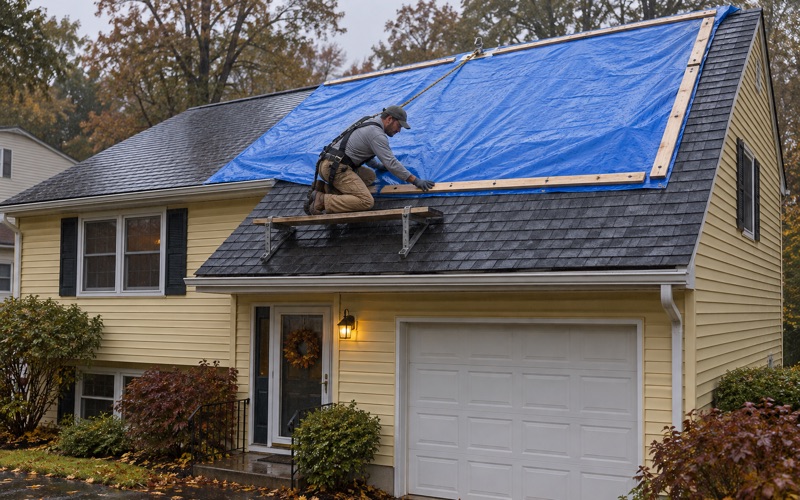
After a wind storm, tarps and temporary repairs go on the same day, with photos taken before anything is moved. We photograph and write up storm damage for your own claim and will meet the insurance adjuster on site when asked, but a homeowners policy and a flood policy cover different perils, and each policy’s own terms decide what it covers.
- 20+ Years in Roofing
- Line-Item Written Estimates
- Same-Day Storm Tarping