Wayne Quality Roofing has spent more than 20 years on roofing in Ramsey and across northern New Jersey, and with a townhouse or condo owner our first question is a simple one: who holds the roof? In an association, the answer sits in the master deed and bylaws rather than on the shingles, so we check it against those documents before a single estimate is written.
That question carries more weight now that New Jersey has changed how associations plan for major repairs. A roof on a shared building is often a common element, and the board is expected to fund its replacement on a schedule set by an outside study. When the roof belongs to the association, the conversation starts with the board and its numbers, and our part is an accurate picture of the roof’s condition.
For owners of detached houses, little of this applies. This page is written for the other group: owners whose roof is shared with neighbors and paid for, at least in part, through monthly dues. Below we walk through what the law asks of a board, how a roof fits into the long-range plan, and what happens when a roof gives out ahead of schedule.
Ramsey’s Shared Roofs and the 2024 Reserve-Study Law
How many owners share a roof
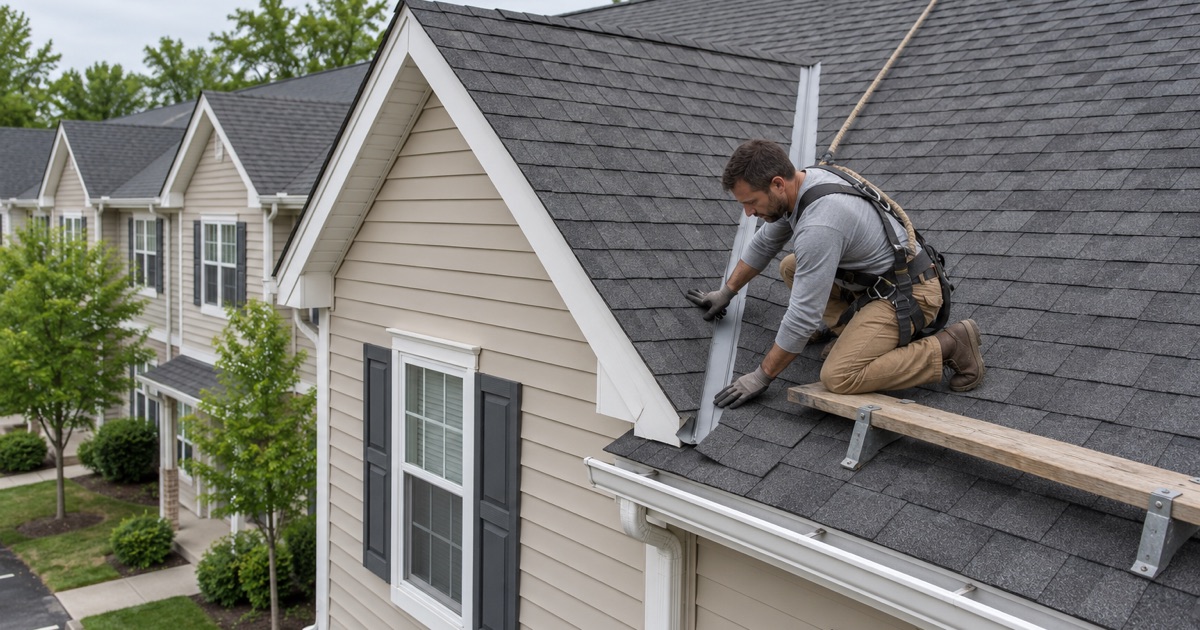
Ramsey is mostly detached houses, but not entirely. The American Community Survey’s 2024 five-year estimates count 4,321 owner-occupied homes in the borough. Of those, 343 are attached single-family houses and 480 sit in buildings with three or more units, which together makes 823 owner households, or roughly one owner in five living under a roof that is likely shared.
That attached and multi-unit stock is where condominium and townhouse associations are found. Real-estate listings name complexes such as Cambridge Heights, Apple Ridge and Timber Valley on Magnolia Road. We have not read their governing documents, and arrangements differ from one community to the next, so who owns which roof is always something to confirm rather than assume.
What the Structural Integrity Law requires
New Jersey’s Structural Integrity Law took effect on January 8, 2024. Under it, every planned real estate development association with $25,000 or more in total common area capital assets must have a capital reserve study. The Department of Community Affairs notes that the requirement applies to all such associations, not only those whose buildings fall under the law’s structural inspection rules.
The study has to be prepared or overseen by a reserve specialist credentialed by the Community Associations Institute, or by a New Jersey-licensed engineer or architect, and board members cannot write it themselves. It must analyze the physical status of the buildings’ common-area components, estimate what repairing or replacing them will cost, and set out a proposed 30-year funding plan.
Deadlines and what the study covers
Associations that had no study in the five years before the law took effect were given one year to get one. Communities formed later must complete a study within two years after the owners elect a majority of the board. The department’s own FAQ lists roofs among the common area assets a study is expected to address, alongside the other major components of the buildings.
Looking for roofing closer to Wallington? See Wallington Roofing.
Where the Roof Sits in the 30-Year Funding Plan
Roofs as scheduled line items
A reserve study treats a shared roof as a component with an expected useful life and a replacement cost. The funding plan then spreads that cost over the years leading up to replacement, so the money is meant to be sitting in the reserve account when the roof reaches the end of its predicted life rather than being raised all at once.
The law ties spending to that schedule. Reserve funds are to be used for components that have reached the end of their established useful life as set out in the most recent study. In practice, the study’s estimate of a roof’s remaining life becomes a planning date the board works toward, which is why an honest reading of the roof’s condition matters so much.
What a roofer can add to the picture
Reserve studies are the work of the credentialed specialist or engineer, not ours. What we can give a board or its property manager is a condition report on the roof itself: the shingles, the flashing, the decking where it can be seen, and the attic underneath. That record gives the person preparing or updating the study real observations to work from.
Every inspection includes a look in the attic as well as on the roof, so a ceiling stain is traced to where water actually gets in. We also say plainly whether a section can be repaired before replacement comes up. A roof that only needs new flashing or a few courses of shingles may have years left, and that is worth knowing before the next study update.
Itemized scopes help a board compare bids
When a replacement does come due, a board usually collects more than one bid. Our written scopes list tear-off, decking, underlayment, flashing, ventilation and gutters as separate lines. That lets the board set two estimates side by side, compare them item by item, and check each against the cost figure the reserve study assumed for that roof.
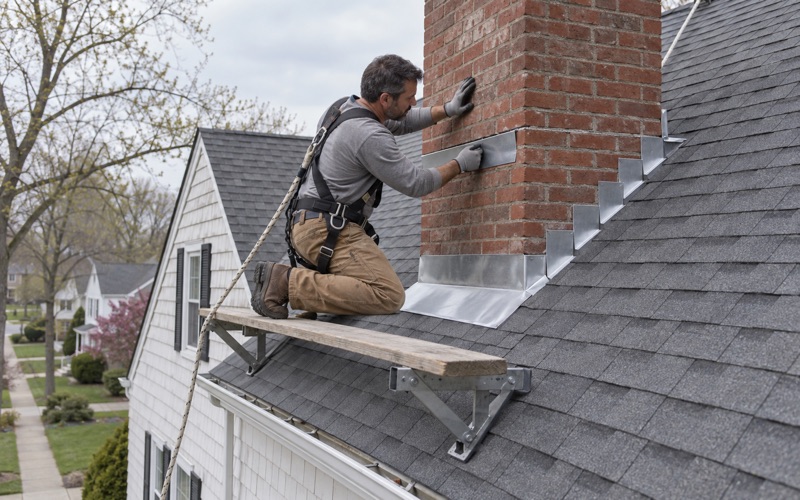
Damaged decking found after tear-off is photographed and shown before it is replaced, at a per-sheet price set in the contract. Step, counter and chimney flashing is replaced with the roof rather than reused, and attic ventilation is checked on every replacement, because a roof that cannot breathe ages from underneath and falls short of the life the study counted on.
When a Roof Fails Before the Study Says It Will
The special assessment or loan clause
Studies are estimates, and roofs do not always follow them. The law anticipates this. Where a capital asset reaches the end of its established useful life earlier than the reserve study predicted, the statute states that nothing in it prevents the association from imposing a special assessment or obtaining a loan to cover the work.
For an owner, an early roof failure can therefore show up as a special assessment on top of regular dues, or as a loan the association repays over time. Neither outcome is automatic. How a particular board responds depends on its own documents, the balance in its reserve account and the vote of its members, so the details vary from one community to the next.
The reduced-funding notice
An association that existed on January 8, 2024 may fund at 85 percent of the study’s plan, but only after sending every owner a notice printed in 20-point bold type. That notice must name the year and amount of any expected special assessment or loan, and the reduced level can be used for no more than five fiscal years.
A seller must give the buyer a copy of the latest such notice before a contract is signed, so anyone buying a unit should ask for it. It is one of the clearest signals of whether the next roof replacement is fully funded or likely to arrive as an assessment, and it is worth reading alongside the study itself.
Storm damage on a shared roof
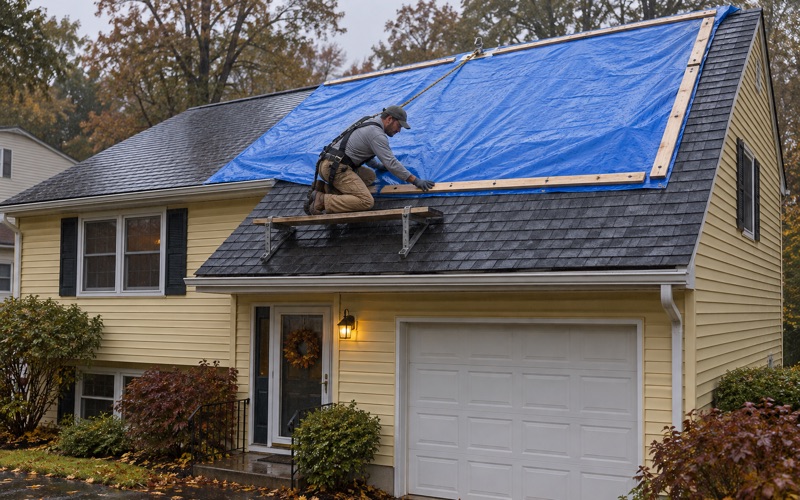
Sudden damage is a different case from a roof that wears out. On the evening of June 12, 2026, during severe thunderstorms, the Ramsey fire department reported a tree down onto a home on Forest Avenue. After a wind storm like that, we put tarps and temporary repairs on an association roof the same day, with photos taken before anything is moved.
We also photograph and write up the damage for the owner’s or association’s own claim, and our crew will meet the adjuster on site when asked. Which policy responds, and for which parts of the building, is set by the association’s documents and its master policy, matters the board and its insurer work out between them.
Questions to Ask Your Board Before a Roof Project
Who holds the roof
Start with the governing documents. Some associations maintain every roof as a common element, others assign townhouse roofs to individual owners, and some split the duty between the two. Checking who holds the roof comes before we price anything, because an estimate written for the wrong party wastes everyone’s time and can stall a repair that needs to happen.
If the roof is yours, the project looks much like one on a detached house, though the association may still require approval of materials and color. If the roof belongs to the association, the board or its manager is the client, and individual owners should bring their concerns to the board first rather than hiring work on their own.
What the current study says
Ask when the last capital reserve study was completed and what remaining life it assigns to the roofs in your part of the community. Ask what replacement cost it assumed and whether the reserve is funded on the full plan or at the reduced level. Those answers show whether a replacement is planned, already funded, or likely to need a special assessment.
Where disputes go
Owners sometimes expect the state to step in when a board falls behind. The Department of Community Affairs publishes guidance on the law, but its FAQ says it does not oversee owner-controlled associations’ compliance with the reserve sections. Disagreements between owners and a board are a matter for civil litigation, so raising a concern early, at a meeting or in writing, is often the practical route.
Before anyone signs
Whether the board or an owner signs, our roof contracts are written to New Jersey’s home improvement rules, including the three-day cancellation notice. At the end of each work day the driveways, lawns and gutters are cleaned, with a magnet sweep for roofing nails, which matters when neighbors share the same walks, parking areas and play spaces.
Owners selling a unit can also ask us for a written roof condition report to hand to the buyer’s inspector. Read alongside the association’s latest notice and its reserve study, it gives a buyer a fuller picture of the roof overhead, how much life it has left, and how its replacement is likely to be paid for.
- 20+ Years in Roofing
- Line-Item Written Estimates
- Same-Day Storm Tarping