Wayne Quality Roofing brings more than 20 years of roofing in Rutherford to every estimate, and the first thing we settle on a job here is which side of a line the building sits on. For most owners the answer keeps the work between them, our crew and the borough. For a smaller group of commercial owners, a state agency takes part before any material is ordered.
That line matters because it changes the paperwork, the schedule and who inspects the finished roof. We would rather explain it plainly at the first visit than let an owner learn it from a stalled permit. The same straight talk applies to the roof itself: we tell you whether it can be repaired before replacement ever comes up, and we put that answer in writing.
Our written scopes break tear-off, decking, underlayment, flashing, ventilation and gutters onto separate lines, so a second estimate can be laid beside ours and compared item by item. Below we walk through where the boundary falls, what it means for a commercial roof, how the state review works, and why a house roof in town never touches it.
Where the Meadowlands District Line Crosses Rutherford
Rutherford is one of the 14 municipalities in the Hackensack Meadowlands District, but the District covers only part of the borough. The New Jersey Sports and Exposition Authority, known as NJSEA and successor to the old Meadowlands Commission, holds land-use authority over that part. Knowing exactly where its boundary runs is the starting point for any roof on the borough’s eastern and southern edge.
The Commercial and Redevelopment Land Inside the Line
NJSEA’s 2015 zoning map of Rutherford draws the District boundary along the borough’s east and south edge. Inside it sit Commercial Park, Redevelopment Area and Environmental Conservation zones around the Route 3 and Route 17 interchange, plus a large Redevelopment Area tract south of Route 3. That is the land where a roofing job can pick up a second agency.
The conservation zones rarely carry buildings of any size, so the roofs that matter here belong to the commercial and redevelopment parcels. Owners of those properties often already know they answer to the state on land use. What surprises some of them is that the same agency also reviews construction plans, which is where a roofing project can stall if nobody planned for it.
Every Residential Zone Sits Outside
The same map leaves every Rutherford residential zone outside the District. That covers the single-family zones, the two-family zone and the apartment zones alike. A homeowner anywhere in those neighborhoods has no reason to contact NJSEA about a roof, and we will never suggest otherwise to justify a longer schedule or a larger price.
Confirming a Parcel Before We Price It
For any building near the interchange or south of Route 3, we confirm the zone before we write the scope. The map is the first check, and the owner’s own records and the borough’s construction office are the second. If a parcel sits close to the boundary, we treat the question as open until someone with authority answers it, rather than guessing from the street.
Looking for roofing closer to Westwood? See Roofing Services in Westwood.
Commercial Roofs Around Route 3 and Route 17
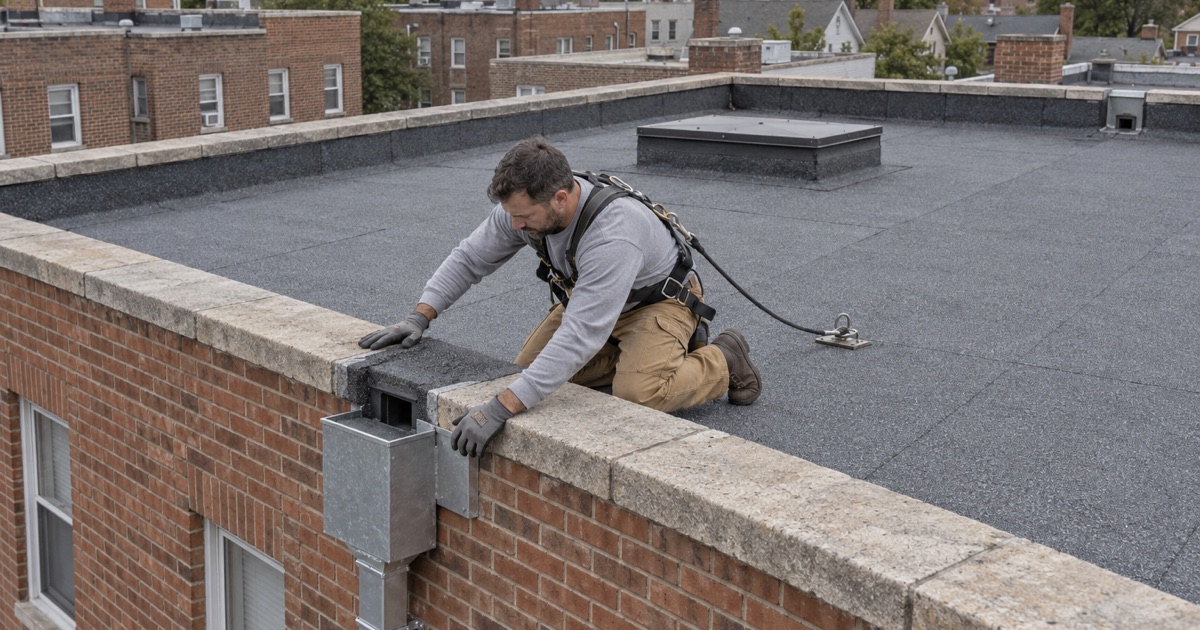
The buildings on Rutherford’s District land are commercial in use, and their roofs tend to look very different from the pitched shingle roofs a few blocks west. That difference shapes both the materials we bring and the permit path the owner follows. Both points belong in the conversation before any number is written down.
Low-Slope Systems We Scope
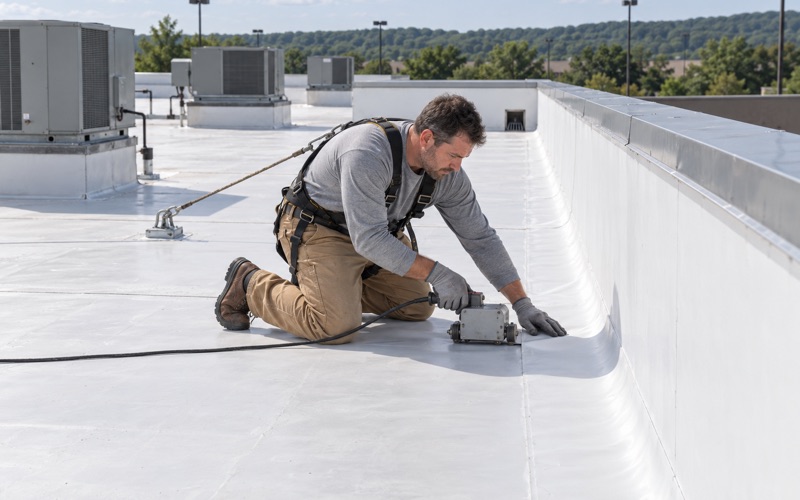
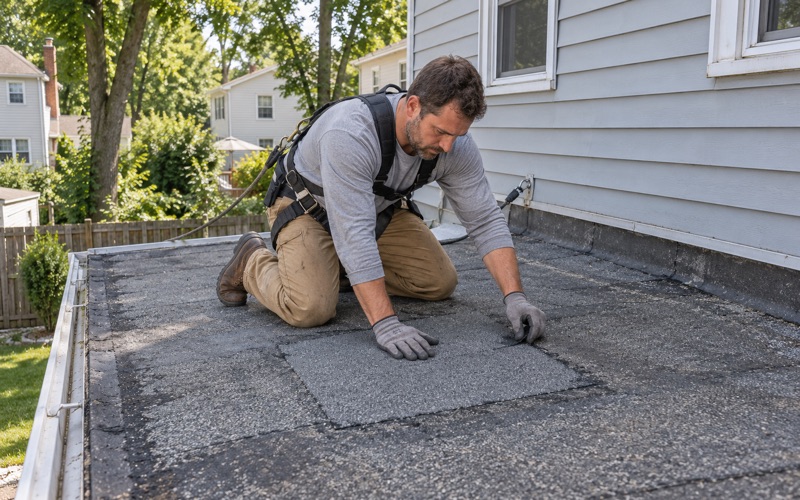
Low-slope commercial roofs are usually covered with a membrane rather than shingles. We work with EPDM rubber, TPO and PVC single-ply membranes, and torch-down SBS or APP modified bitumen, and the right choice depends on the deck, the drainage and what sits on the roof. Equipment curbs, drains and parapet flashing get as much attention as the open field of the membrane.
A flat roof that holds water usually tells us where to look first. Before pricing anything, we follow a leak from the ceiling inside the building as well as across the membrane, because water on a low-slope roof can travel a long way from the opening that let it in. The repair goes where the water actually enters, not where the stain happens to show.
Why a Commercial Re-Roof Differs From a House
New Jersey’s ordinary-maintenance rule, N.J.A.C. 5:23-2.7, covers roof covering on detached one- and two-family dwellings. A commercial building is outside that rule, so a commercial re-roof can fall under the Uniform Construction Code’s permit process. In Rutherford that permit comes from the borough’s construction official, but on District land the borough is not the first stop.
Writing a Scope a Property Manager Can Compare
Commercial owners usually collect several bids, so our written scope separates tear-off, deck repair, insulation, membrane, flashing and drainage work into their own lines. Each line carries its own price, which means a bid that leaves out edge metal or drain work shows up as a gap rather than a lower total. A property manager can then compare what each contractor actually intends to do.
NJSEA Plan Review and the Certificate of Plan Release
NJSEA’s Application Process and Forms page says the agency is responsible for reviewing construction plans for new construction, alterations and renovations in the District, checking them against the New Jersey Uniform Construction Code. The page never mentions roofs. Our reading, which we share with owners as a reading rather than a ruling, is that a commercial re-roof needing a construction permit on District land is an alteration that goes through that review.
The Submission and Plan Review Fee
The applicant digitally submits the Uniform Construction Code subcode forms and plans to NJSEA and pays a plan review fee to the agency. We do not quote that fee or promise how long the review lasts, because neither is published where we could confirm it. What we can do is hand the owner or their design professional a clear roof scope and product details to attach.
Certificate of Plan Release, Then the Borough Permit
When the plans comply, NJSEA issues a Certificate of Plan Release and sends two sets to the municipal construction official. Only then does Rutherford’s construction office at Borough Hall, 176 Park Avenue, issue the construction permit. Just three District towns handle the full review themselves, and Rutherford is not among them.
That order matters for scheduling. A commercial roof on District land should not be booked for tear-off until the borough permit is in hand, and the borough permit waits on the state release. We build that sequence into the timeline we give a property manager, so a crew date is never set ahead of the paperwork.
Inspections, Final Review and the Certificate of Completion
During the work, the applicant calls the municipal construction official for inspections, the same as anywhere else in town; the Building Department keeps weekday hours of 8:30 a.m. to 4:30 p.m. and takes permit email at permit@rutherfordboronj.com. After the job is finished, NJSEA performs its own final inspection and issues a Certificate of Completion or occupancy approval.
Where a certificate of occupancy applies, the borough’s construction official issues it after the state’s sign-off. For an owner, the practical point is that two agencies look at the finished building, not one. We keep the roof edges, the job site and the paperwork in a condition that makes both visits routine.
Zoning Certificates for Rooftop Additions
Plan review is separate from the NJSEA zoning certificate. Under N.J.A.C. 19:4-4.2(a)1, construction, remodeling or reconstruction in the District needs a zoning certificate first, with building demolition and maintenance excepted. NJSEA’s page ties zoning certificates to new buildings, additions, site improvements and changes in use, and it does not mention roofs at all.
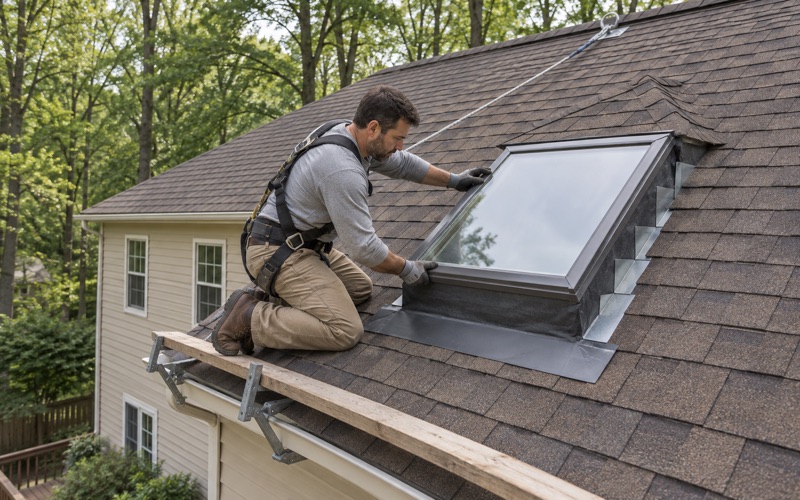
Where a project adds something to a roof, such as a rooftop enclosure or a new structure above the existing deck, whether it counts as an addition is the agency’s call. NJSEA’s Zoning Officer of the Day answers those questions at zod@njsea.com or 201-460-1700. We would rather an owner put the question there early than discover the answer after materials arrive.
Why a Rutherford House Deals With the Borough Alone
Because every residential zone lies outside the District, a homeowner re-roofing in Rutherford never involves NJSEA. No state plan review and no District inspection applies to a house here. Any owner told otherwise by a contractor should ask to see the rule in writing before signing anything.
Ordinary Maintenance on One- and Two-Family Homes
State rules treat roof covering on detached one- and two-family dwellings as ordinary maintenance under N.J.A.C. 5:23-2.7. That category matters here, because one-unit detached homes are 57.0 percent of Rutherford’s housing and two-unit buildings another 16.7 percent. When a house job goes beyond the covering, such as reframing or adding a dormer, the borough’s construction and zoning offices are the place to ask.
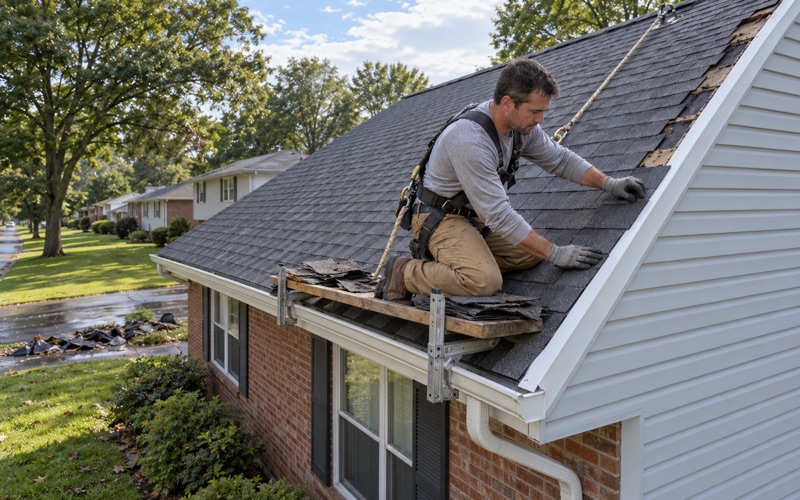
Ordinary maintenance does not mean anything goes. The rehabilitation subcode, N.J.A.C. 5:23-6, calls for a tear-off rather than an overlay when a roof already carries two or more layers, or is slate, wood shake or tile. Our contracts follow New Jersey’s home improvement rules, including the three-day cancellation notice, whatever the size of the house.
What Older Rutherford Roofs Bring to the Job
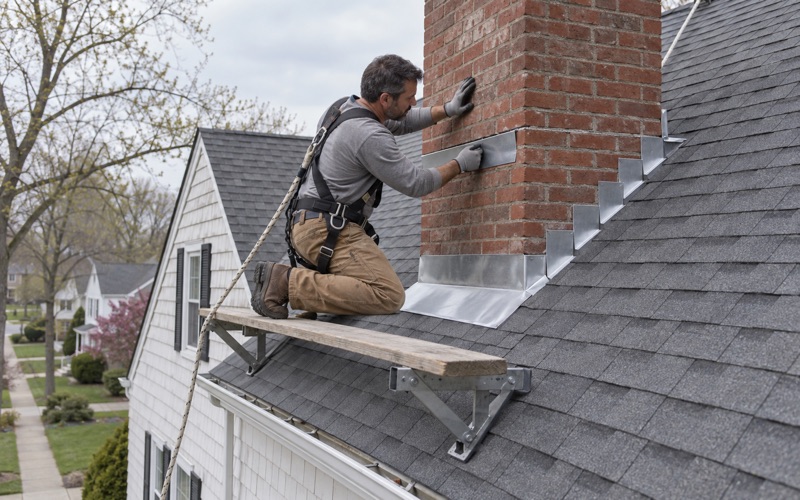
Rutherford’s homes are old: 42.8 percent of units date to 1939 or earlier, and another 34.4 percent to the years from 1940 through 1959. On houses of that age, a re-roof often reaches past the shingles to decking, chimney flashing, box gutters and porch roofs, and earlier roof layers may still be in place. We price those possibilities as separate lines rather than surprises.
Older capes and other homes with shallow eaves are prone to ice dams, so we add a self-adhering eave membrane and check attic ventilation rather than relying on new shingles alone. Ventilation gets checked on every replacement, because a roof that cannot breathe ages from underneath. Painted trim and fascia on pre-1978 homes are handled under the EPA lead-safe rule.
Leaks, Flashing and Decking on a House
Every leak call we take includes a look in the attic as well as on the roof, so the water is traced to its entry point before we price anything. When the roof comes off, step, counter and chimney flashing is replaced with it, never reused under new material. Damaged decking is photographed and shown to the owner first, at a per-sheet price already written into the contract.
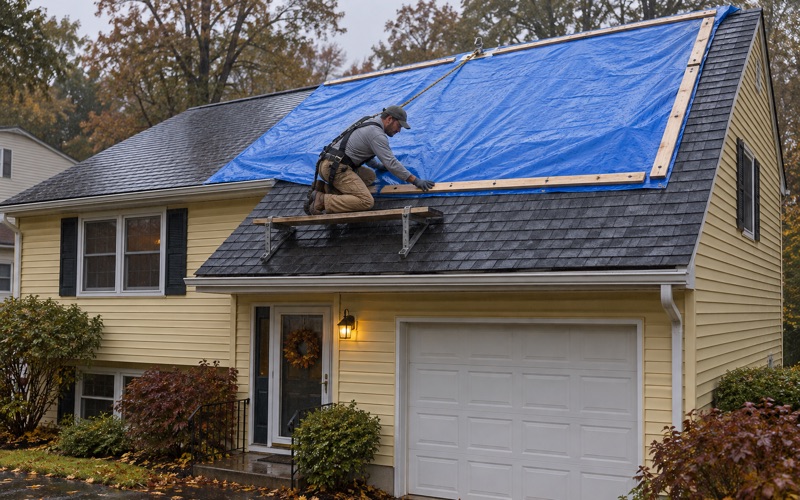
After a wind storm, tarps and temporary repairs go on the same day, and we photograph the damage before anything is moved. Those photos and a written description go to the owner for their own claim. At the end of each workday the driveway, yard and gutters are cleaned, including a magnet sweep for roofing nails.
- 20+ Years in Roofing
- Line-Item Written Estimates
- Same-Day Storm Tarping