Wayne Quality Roofing brings more than 20 years of experience to roofing in Saddle Brook, and one question shapes the planning of jobs here more than it does elsewhere: how will the material reach the roof? Bundles of shingles, replacement trusses and rooftop equipment all have to go up somehow. The answer can decide whether a separate township permit belongs on the calendar well before the crew arrives.
Before any of that, we start where the trouble is. A leak call gets a look in the attic as well as on the roof, so the water is traced to its real entry point before a price is written. You also hear plainly whether the roof can be repaired, and that answer comes before anyone mentions replacement.
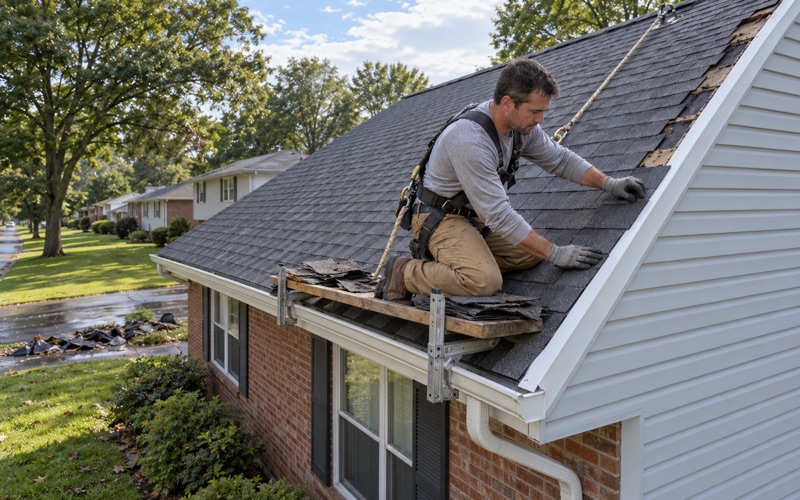
When replacement is the right call, the written scope breaks tear-off, decking, underlayment, flashing, ventilation and gutters into separate lines, which lets you set two estimates side by side and compare them item by item. This page focuses on the part of a Saddle Brook job that happens before the first shingle comes off: getting materials and equipment up to the roof the right way.
Saddle Brook’s Crane Permit Under Ordinance 1628-17
A Township Rule Most Towns Don’t Have
Saddle Brook is one of the few municipalities around here with its own crane law. Ordinance 1628-17, which the township’s ordinance archive lists as passed August 3, 2017, says no one may operate a crane within the township without first applying for and obtaining a crane permit. The ordinance’s own preamble explains why: cranes here work in a dense setting, often close to homes, offices and pedestrians.
The ordinance does not write its own definition of a crane. It borrows two: the state Licensure of Crane Operators Act and the federal OSHA rule for cranes and derricks in construction, known as Subpart CC. That borrowing matters on a roof job, because whether a given machine counts as a crane in Saddle Brook follows from how those two laws treat it.
The Construction Official Signs Off
Applications go to the Construction Official at the Township of Saddle Brook Building Department, 55 Mayhill Street. The township’s current Crane Permit Application form, dated September 2026, asks for the work site’s block and lot, the property owner, the crane owner, up to two operators and the crane’s lift capacity. It also carries a separate hold-harmless agreement page.
The supporting documents run to a dozen items. Among them are the operator’s certification from NCCCO, OECP or the Crane Institute of America, a New Jersey crane license, the crane’s latest inspection, a signal-person qualification and the construction permit for the work where one applies. None of that is paperwork a homeowner should have to chase, because it belongs to whoever owns and runs the crane.
Insurance and What a Violation Costs
The insurance schedule is what tends to surprise people. The township must be named as an additional insured on general liability of $10 million per occurrence, with $1 million of auto coverage, a $5 million umbrella and $5 million of contractors pollution liability on top. A small hauler without that coverage simply cannot take a Saddle Brook lift.
Skipping the permit is not a paperwork slip. A violation can bring a fine of up to $500, up to 10 days, or both, with each day counted separately, plus an immediate shutdown of the crane site. Using an unlicensed operator runs $2,000 to $20,000 per violation. A shutdown with the old roof already off leaves a house open to the weather.
Looking for roofing closer to Ramsey? See Roofing Services in Ramsey.
Five Days’ Notice, a $100 Fee and a 60-Day Window
Lead Time Belongs in the Schedule
The ordinance requires the crane permit to be issued at least five days before anyone starts using the crane. Issued, not applied for: the clock runs from the Construction Official’s approval, so the paperwork has to be in well before that. On a job that needs a lift, we treat those five days as a fixed piece of the schedule rather than something to squeeze in at the end.
That is why the delivery method is settled when the start date is set. If the supplier’s truck or a crane service needs a permit, the application goes in early enough that approval lands before the tear-off crew is booked. A roof stripped to the deck while everyone waits on a permit is exactly the situation this planning is meant to avoid.
Fees, Renewal and the 60-Day Clock
The fee is $100 for the initial permit and $50 to renew or extend it. Once issued, a crane permit is good for 60 days, and the township form states plainly that permits expire 60 days from the date issued or renewed. For a single-day lift on a house, that window is generous.
Commercial work is where the clock matters. A larger re-roof that stages materials at the start and lifts equipment back up at the end can drift past the expiration date if weather or a supply delay pushes the finish. Tracking that date and renewing for $50 before it lapses costs far less than restarting the application after the fact.
When the Five Days Can Be Waived
The ordinance gives the Construction Official discretion to waive the five-day lead time in emergent situations. That is a judgment the township makes case by case, not a shortcut anyone can claim. If a storm leaves a roof open and a lift is the only practical way to stage repair material, the request goes to the Construction Official with the reasons spelled out.
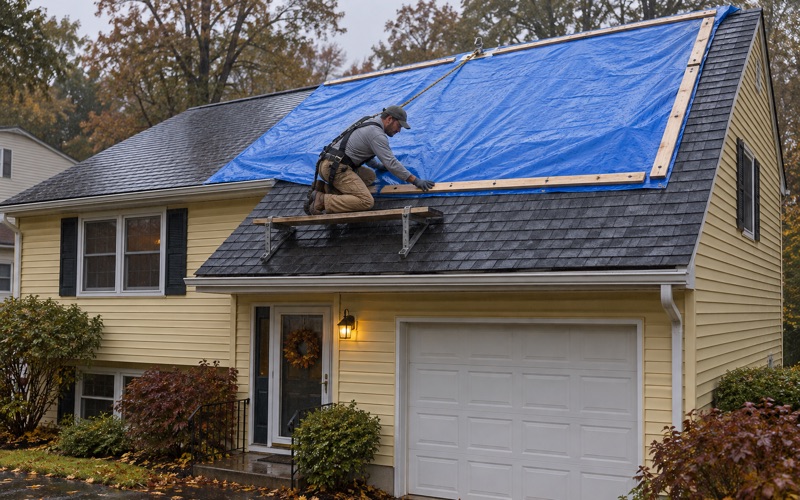
Most emergency roof work does not need a crane at all. After a wind storm we put tarps and temporary repairs on the same day, photographing the damage before anything is moved, and those photos are written up for the owner’s own claim. Material for the permanent repair can then arrive on a schedule that respects the township’s notice period.
Boom-Truck Roof Deliveries and the Federal Crane Rule
What the OSHA Exclusion Covers
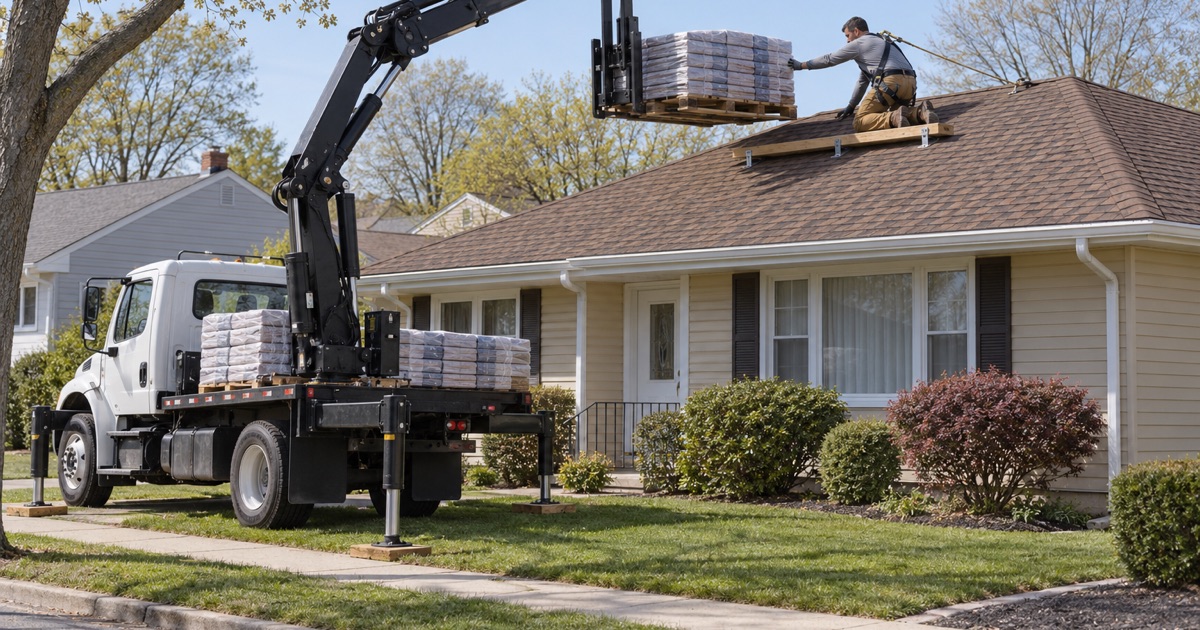
Many roofing suppliers deliver shingles with an articulating crane mounted on the truck, usually called a knuckle-boom delivery truck, and set the bundles straight onto the roof. The federal rule at 29 CFR 1926.1400 excludes that kind of delivery from its crane standard only in limited cases. One case covers a truck that simply moves material to the ground without arranging it in a sequence for hoisting.
The case that matters for roofing covers sheet goods or packaged materials placed onto a structure with a fork or cradle, and the rule names roofing materials among its examples. That exclusion applies only when the truck crane is equipped with a properly functioning automatic overload prevention device. Without a working device, the same delivery falls back inside the federal crane rule.
Where the Exclusion Stops
The exclusion never reaches a crane that holds, supports or stabilizes material while construction work happens around it. It also does not cover prefabricated components such as roof trusses, or structural steel. A boom truck that sets pallets of shingles and leaves is one thing, and the same truck holding a load in position while a crew works is another under the federal rule.
Forklifts sit in a separate exclusion, except when one is set up to hoist a suspended load by winch or hook. The practical point is that the name painted on the side of the truck settles nothing. What the equipment does during the lift, and how it is equipped, decides which side of the line it lands on.
A Question for the Construction Official
Because Saddle Brook’s ordinance defines a crane through the federal rule, a rooftop delivery that falls outside the OSHA crane standard may well fall outside the township chapter too. Nothing we have read shows the township applying the chapter to shingle deliveries, though, and nothing says it never would. Whether a particular delivery needs a crane permit is the Construction Official’s call.
So before a Saddle Brook start date, we confirm with the supplier what truck is coming and whether its overload prevention device is working. If there is any doubt, we ask the Building Department at 201-843-7111 rather than guess. Settling that on paper costs a phone call, while settling it on delivery day can cost the whole day.
Street Lifts, Neighbor Lots and Commercial Rooftops
When the Crane Sits Off the Property
Tight lots are a common reason a lift happens from the street. The ordinance requires written permission whenever the crane site is on public property, a township right-of-way or someone else’s land, and that permission goes in with the application. A truck parked on the street to reach a back slope, or set up in a neighbor’s driveway, needs that document first.
Asking a neighbor for written permission is easier weeks ahead than on the morning of the lift. Where a lift from next door is the only reasonable approach, we raise it with the owner during the estimate so the conversation happens early. Either way, the driveway, yard and gutters are cleaned at the end of each work day, including a magnet sweep for nails.
Trusses and Rooftop Units on Route 46 and Market Street
The chapter applies most plainly to commercial buildings. Replacing roof trusses or lifting rooftop HVAC units onto a flat roof along Route 46 or Market Street is crane work by any reading, and the federal exclusion for packaged deliveries does not cover trusses at all. On those jobs, the crane permit is a line in the plan from the first meeting.
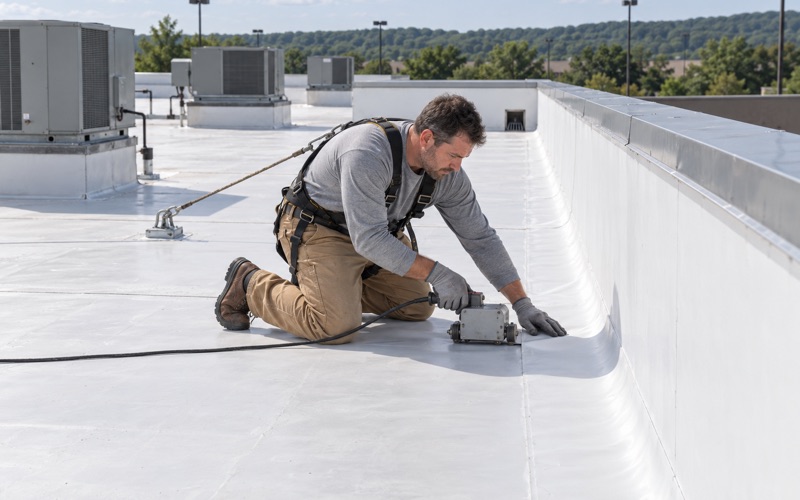
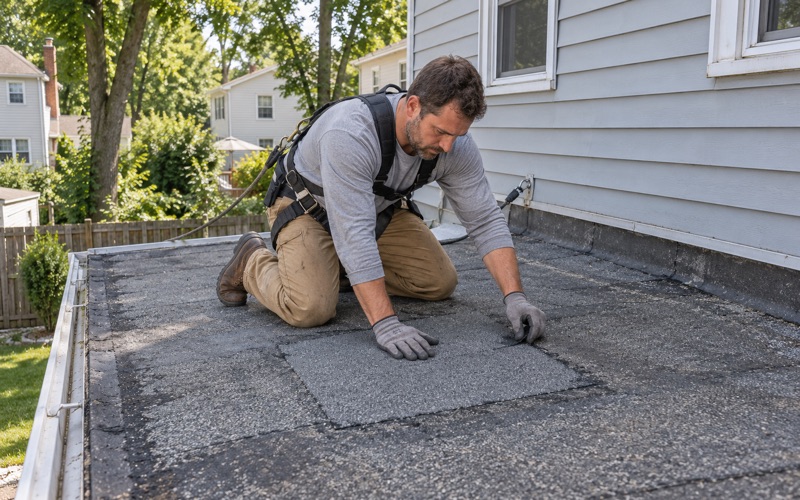
A low-slope commercial roof may carry EPDM rubber, a TPO or PVC single-ply membrane, or torch-down modified bitumen. When a unit comes off for the roof work and goes back on afterward, that can mean two lifts under one permit. We map the sequence so the curb flashing is finished and inspected by our crew before the unit returns.
The Houses Behind Most Re-Roofs Here
Most Saddle Brook roof work is residential and never goes near a crane. Census survey figures put nearly half of the township’s 5,623 housing units in buildings from 1940 to 1959, and about 64 percent are single-family detached houses. Two-family houses come next, with 873 units in two-unit buildings, so one roof often covers both an owner’s flat and a tenant’s.
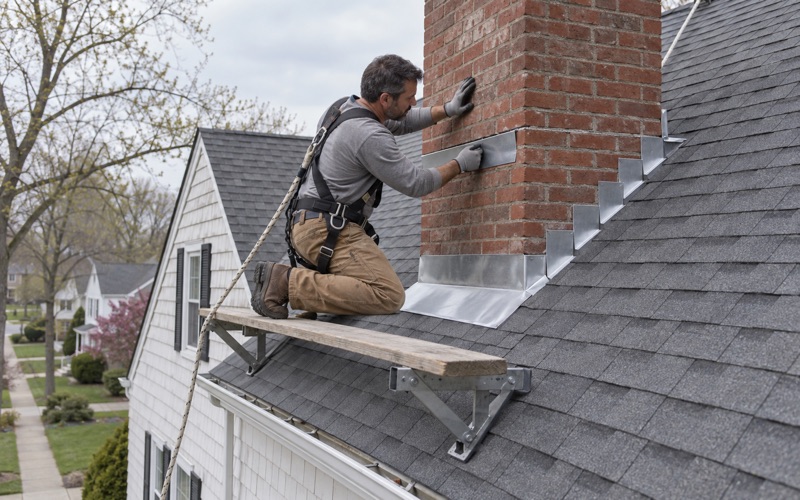
On houses of that age, the flashing and the attic matter as much as the shingles. Step, counter and chimney flashing is replaced with the roof rather than reused under new material, and attic ventilation is checked on every replacement, because a roof that cannot breathe ages from underneath. Contracts follow New Jersey’s home improvement rules, including the three-day cancellation notice.
- 20+ Years in Roofing
- Line-Item Written Estimates
- Same-Day Storm Tarping