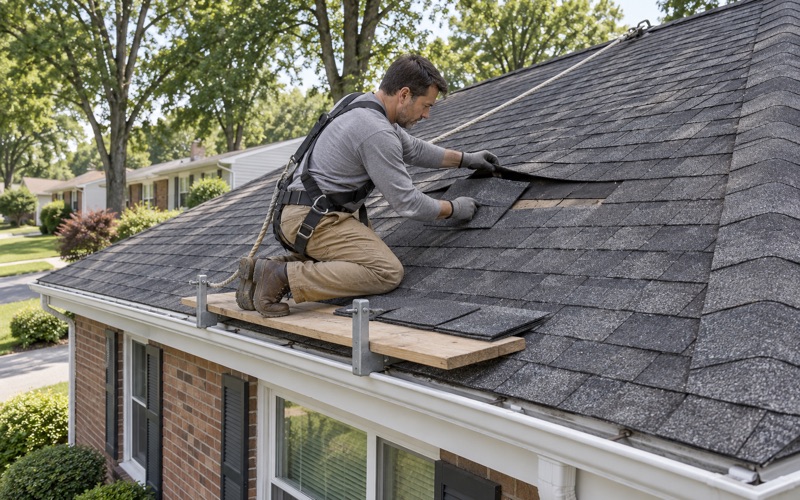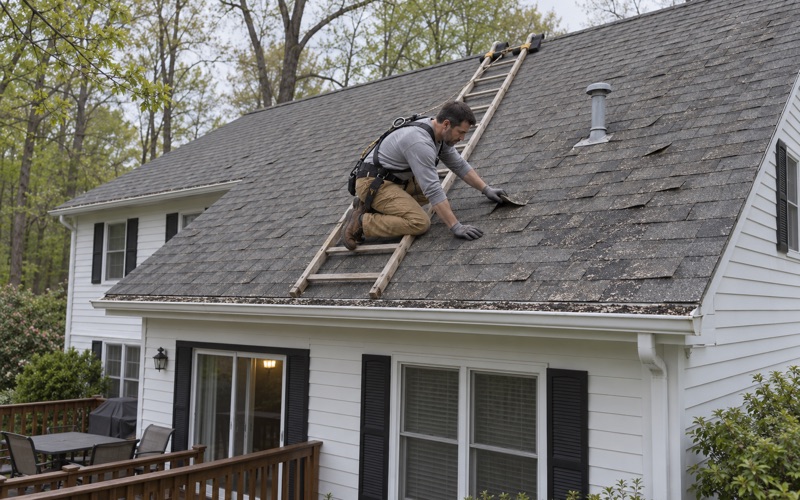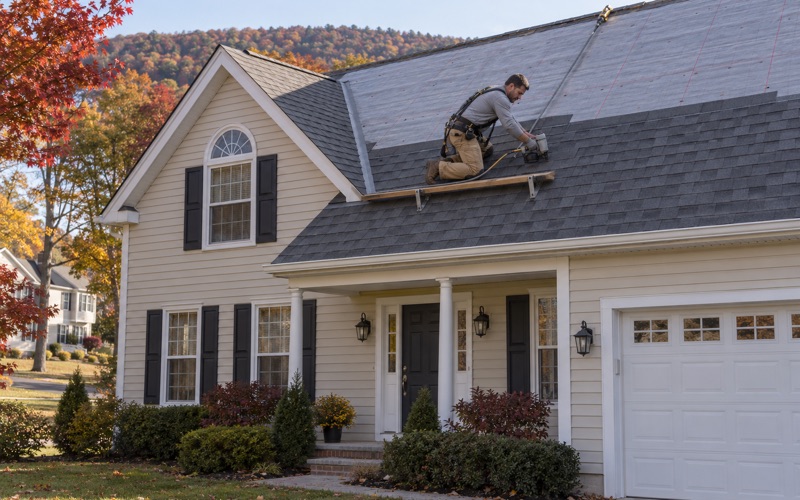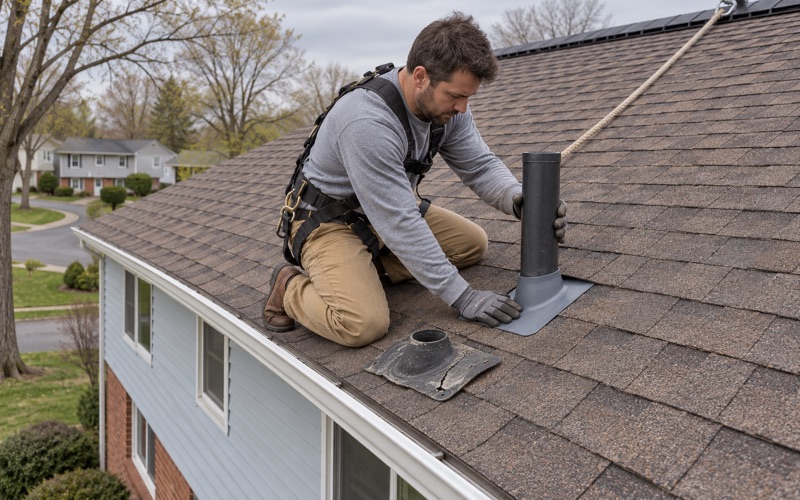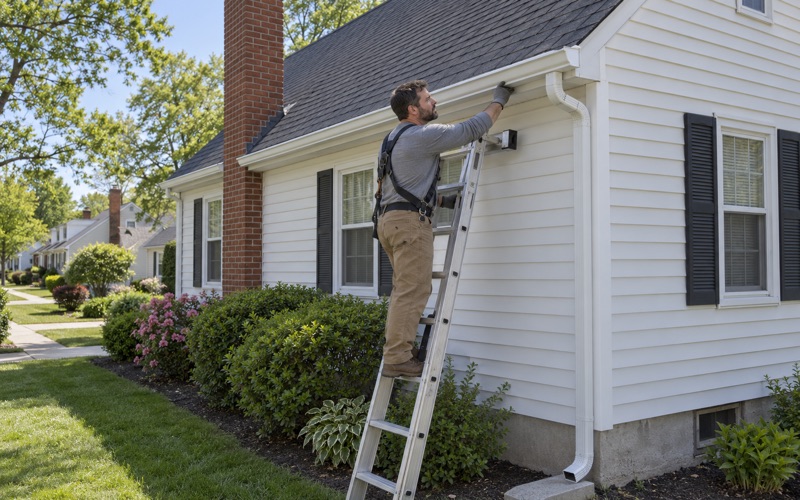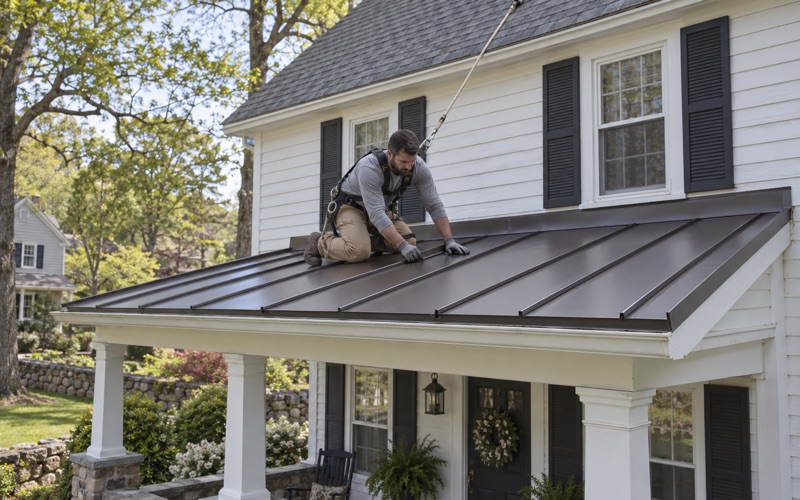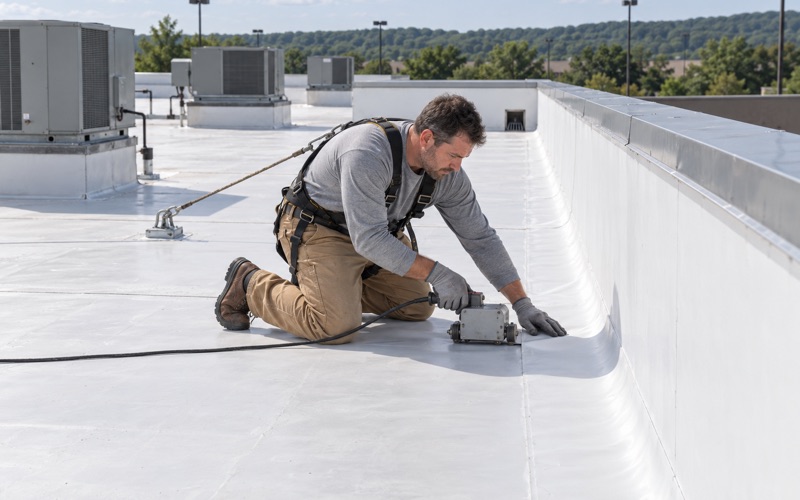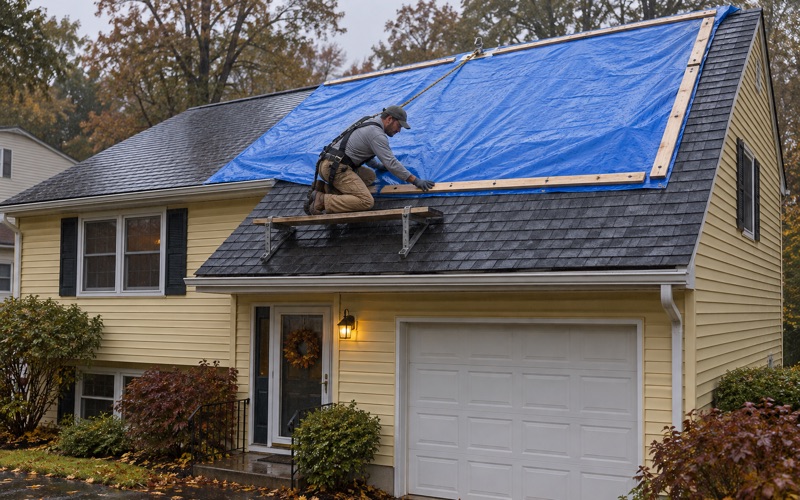
Wayne Quality Roofing approaches roofing in Suffern with more than 20 years in the trade and one fact set firmly in mind: this is a New York village, so New York law governs every roof here. That changes who signs off on the work, what the contract has to say, which license a contractor must carry and how sales tax lands on the final bill.
Our visits start the same way whatever the paperwork. On a leak call we look in the attic as well as on the roof, so the water is traced to the place it actually enters before anything is priced. Then we give a straight answer on whether the roof can be repaired, and replacement only comes up when a repair will not hold.
The sections below follow the order a Suffern owner usually meets these questions: the permit, the contractor and contract, the tax line, and the buildings themselves. Fewer than a third of the homes here are detached houses, and that shapes how much of a roof gets replaced and what the invoice looks like at the end.
New York Rules Govern a Suffern Roof
A Village on the New York Side of the Line
Suffern is a village in the Town of Ramapo, Rockland County, and it sits next to Mahwah on the New Jersey side. A homeowner who has read about New Jersey’s roofing rules, or heard a neighbor across the line describe them, should set that reading aside. New Jersey’s construction exemptions, contractor registration and tax certificates have no force on a Suffern roof.
The rules that do apply come from New York State and from Rockland County. We write every Suffern estimate and contract around the New York requirements described on this page, not around paperwork built for a job in another state, and we explain each requirement to the owner before anything is signed.
What the Uniform Code Says About Permits
New York’s Uniform Fire Prevention and Building Code is administered under 19 NYCRR Part 1203. Section 1203.3(a)(1) requires every code-enforcing municipality to require building permits for work that must conform to the Uniform Code, and it lets a municipality exempt only the categories it lists. Those are small sheds, temporary sets, window awnings, low partitions, finish work such as painting and tiling, listed portable equipment, like-for-like equipment swaps and certain repairs.
The repair category covers work that does not affect the structural system, the means of egress or the fire protection system. Roofing and re-roofing are not named anywhere on that list. A municipality may exempt a category only where its own code enforcement program expressly sets it out, so the answer for a particular Suffern roof lives with the village, not with a general rule.
Asking the Village Building and Zoning Department
The Village of Suffern Building and Zoning Department works from the top floor of Village Hall at 61 Washington Avenue, and the office line is (845) 357-2603. The office is open from 8:00 a.m. to 4:00 p.m., Monday through Friday. We ask the department before a re-roof starts, and we suggest the owner make the same call so the answer comes straight from the office that enforces it.
The village’s posted building permit application is a general form for work that will demolish, erect, alter or convert a building. It asks for the estimated cost and whether the property lies in a floodplain, and it states that a permit expires one year from the date it is issued. We schedule a tear-off with that window in mind so the permit and the job line up.
Looking for roofing closer to Hanover? See Roofing Services in Hanover.
A Rockland County License and a Written Contract
The County Home Improvement License
Chapter 286 of the Laws of Rockland County requires anyone in the home improvement business to hold a Rockland County home improvement license, issued through the county Office of Consumer Protection. Work is not supposed to start before that license issues. A Suffern owner comparing bids can ask every contractor for the county license and proof of insurance, and should expect both to be produced without fuss.
That advice is the county’s own. In March 2025 the Office of Consumer Protection warned of roofing scams around Rockland County, including impostors posing as a known roofing company and an elderly resident who paid $60,000 for a roof replacement. Residents were told to ask for a Rockland County contractor license and insurance, and not to pay in full upfront.
What General Business Law Section 771 Puts in Writing
New York’s General Business Law Section 771 requires a home improvement contract to be written and signed by all parties. It must give the contractor’s name, address and telephone, approximate start and substantial-completion dates, and a description of the work and materials with make, model or other identifying information. If progress payments are used, the schedule has to bear a reasonable relationship to the work performed.
Payments received before completion must be deposited as the Lien Law requires, or the contractor may post a bond, contract of indemnity or irrevocable letter of credit. Our scopes already list tear-off, decking, underlayment, flashing, ventilation and gutters as separate lines, which suits the statute’s call for a plain description and lets an owner compare two bids item by item.
The Third Business Day
Every New York home improvement contract must tell the owner that they may cancel until midnight of the third business day after signing. The owner also receives a copy of the agreement, signed by the contractor, before any work is done. We hand that signed copy over at signing, so the cancellation date is in the owner’s hands from the start.
One more line in our contracts matters once the old roof is off. Damaged decking is photographed and shown to the owner before any of it is replaced, at a per-sheet price set in the contract, so a surprise under the shingles never turns into a surprise on the invoice.
Whole Side or Spot Repair: How New York Taxes a Roof
When the Job Is a Capital Improvement
The New York State Department of Taxation and Finance sorts roof work into two groups in Publication 862. Complete replacement of a roof on the entire building, the complete side of a peaked roof, or the complete roof on a wing, turret or dormer counts as a capital improvement. With a properly completed Form ST-124, the Certificate of Capital Improvement, the contractor collects no sales tax from the customer.
The contractor still pays tax to its supplier on the materials it buys, so tax is not gone from the job entirely. What changes is whether a sales tax line appears on the owner’s invoice. When a Suffern job meets the capital improvement description, our estimate names that category so the Form ST-124 step is not missed at signing.
When the Job Is a Taxable Repair
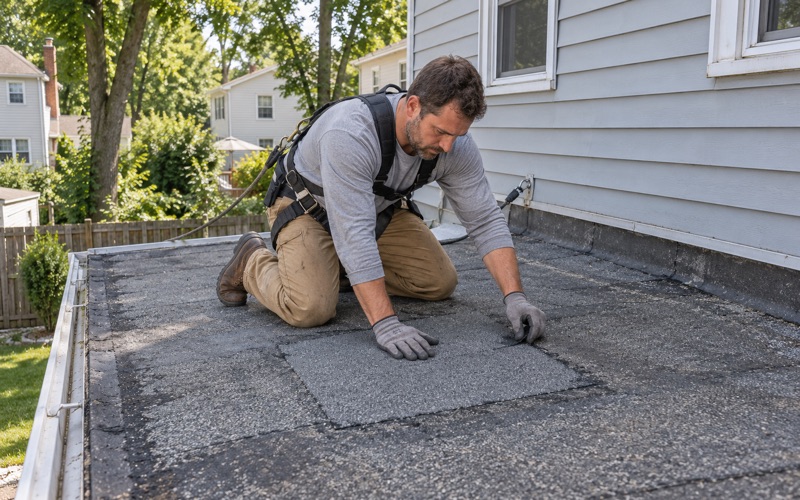
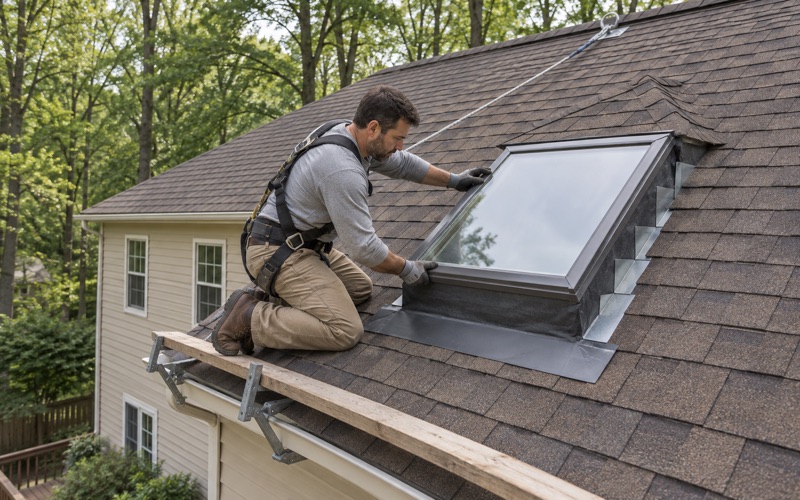
Repair or spot replacement of any roof type, from asphalt shingle to slate, metal or single ply, is a repair, maintenance or installation service, and sales tax is collected on it. So are roof coatings and the repair or replacement of flashings, drip edges, valleys, skylights and partial gutter systems. A patched corner and a replaced skylight are both taxed, even when the bill is substantial.
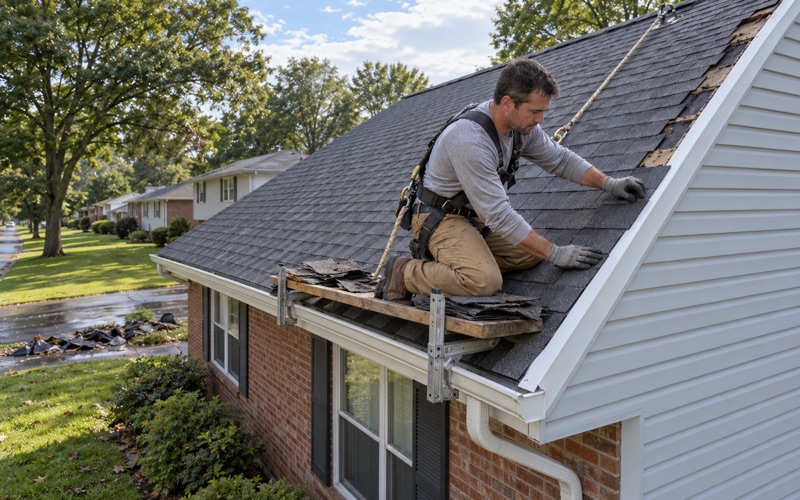
That puts real weight on scope. A full replacement of one side of a peaked roof can carry no sales tax, while a few squares of new shingles on that same side carry the tax. Because we settle whether a repair will hold before replacement is discussed, we can show the owner where the tax line falls under each option.
Flashing on Its Own Versus With the Roof
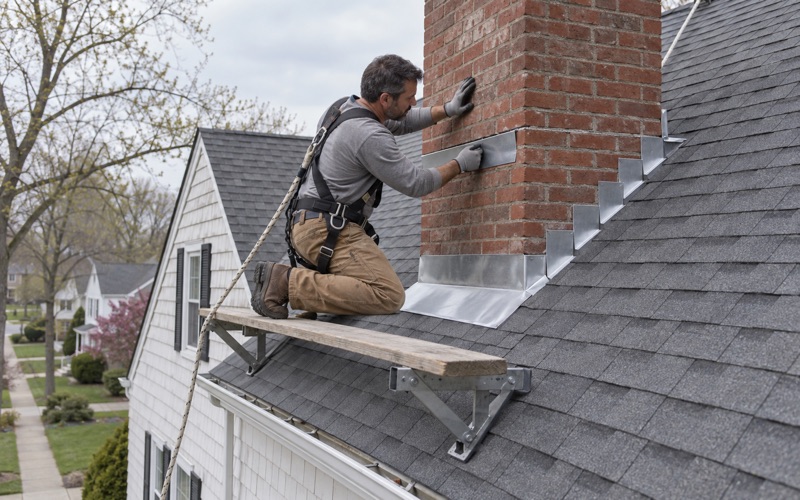
On our replacements, step, counter and chimney flashing are replaced with the roof rather than reused under new material. Replaced on its own, flashing is a taxable repair under Publication 862. An owner who has been patching around a chimney for years may find that folding the flashing into a complete side is both the sounder fix and the cleaner line on the bill.
Attached Homes and Small Buildings in Suffern
What the Housing Count Shows
Suffern’s housing is mostly not detached. The Census Bureau’s 2024 American Community Survey five-year count lists 1,354 of 4,784 housing units, or 28.3%, as one-unit detached homes. Another 758 units are one-unit attached, and 1,208 sit within buildings of three or four units.
Owners hold much of that attached and small-building stock. Of 3,102 owner-occupied units, 641 are attached and 1,092 are housed in three- or four-unit buildings, together 1,733 homes, or 55.9% of the owner-occupied total. For those owners, the line between a complete side and a patch is often the line that decides the bill.
Shared Roofs and Who Holds Them
The Census count describes a building’s structure, not who owns its roof. A townhouse may be held outright, or its roof may sit with an association, and the answer changes who signs the contract. In townhouse and condominium communities we check who holds the roof against the association’s documents before any estimate is written.
On attached homes the work also meets a neighbor’s roof in a physical sense. Where one owner’s section joins the next, flashing and underlayment have to tie in cleanly so water does not track into the adjoining attic. We plan that seam before tear-off, and the crew cleans the driveway, yard and gutters at the end of each work day, including a magnet sweep for roofing nails.
Older Houses and the 1970s Stock
The 1970s were Suffern’s busiest building decade, with 1,703 units, about 35.6% of the housing count. Another 850 units, or 17.8%, were built in 1939 or earlier. We check attic ventilation on every replacement, because a roof that cannot breathe ages from underneath, and older capes, ranches and split-levels with ice-prone eaves get an eave membrane along with that check.
Suffern’s forecasts come from the National Weather Service office at Upton under zone NYZ069, Rockland. When a wind storm does pass through, we put tarps and temporary repairs on the same day, with photos taken before anything is moved. Owners getting ready to sell can also ask for a written roof condition report to hand to the buyer’s inspector.
- 20+ Years in Roofing
- Line-Item Written Estimates
- Same-Day Storm Tarping