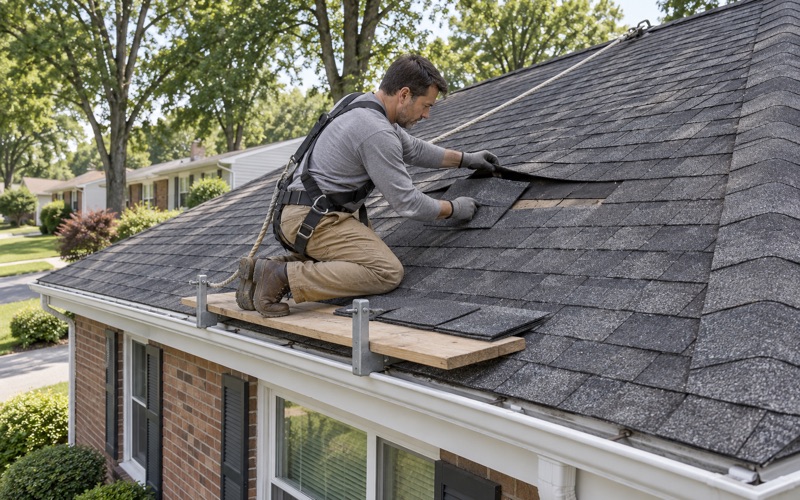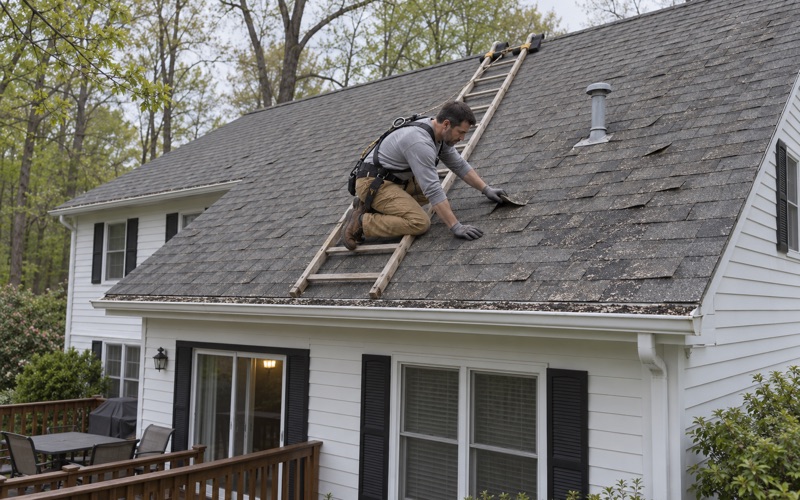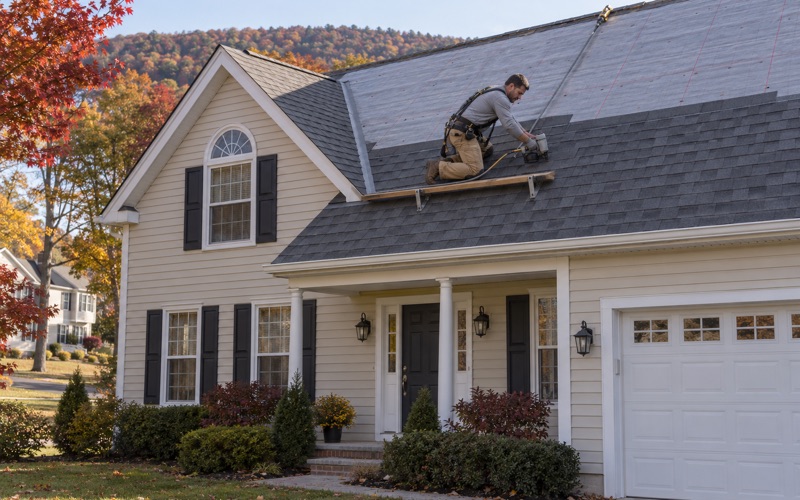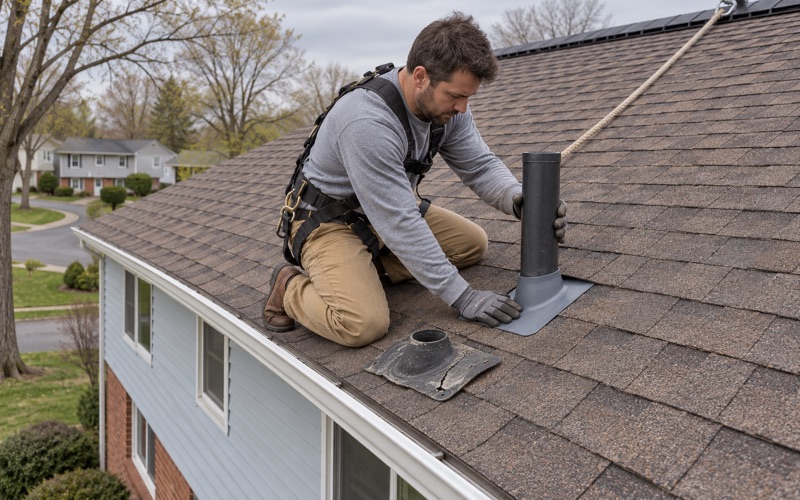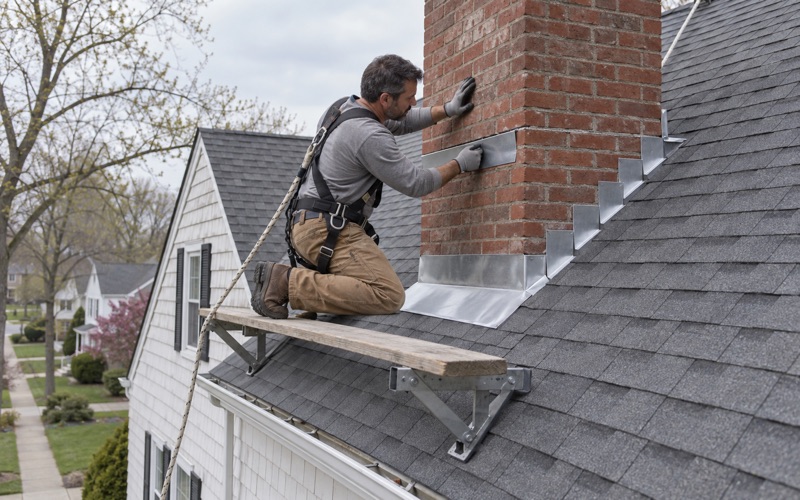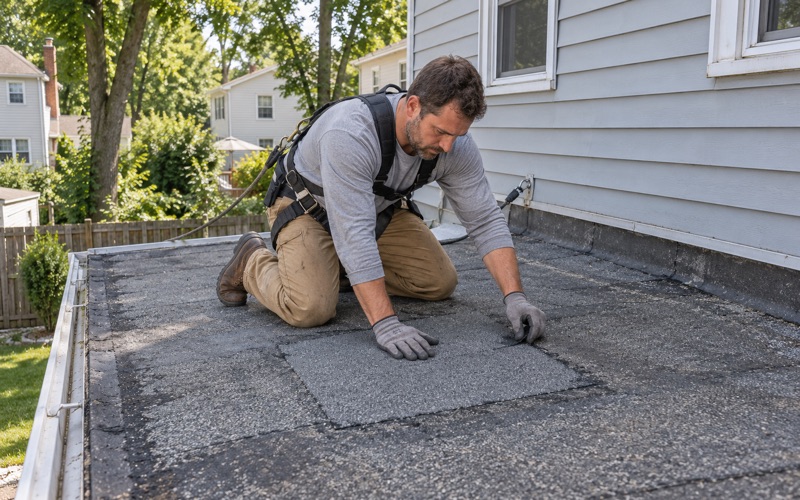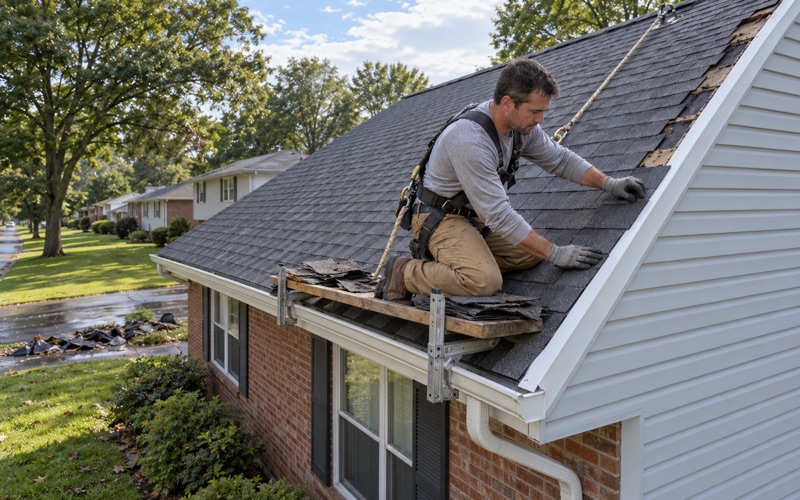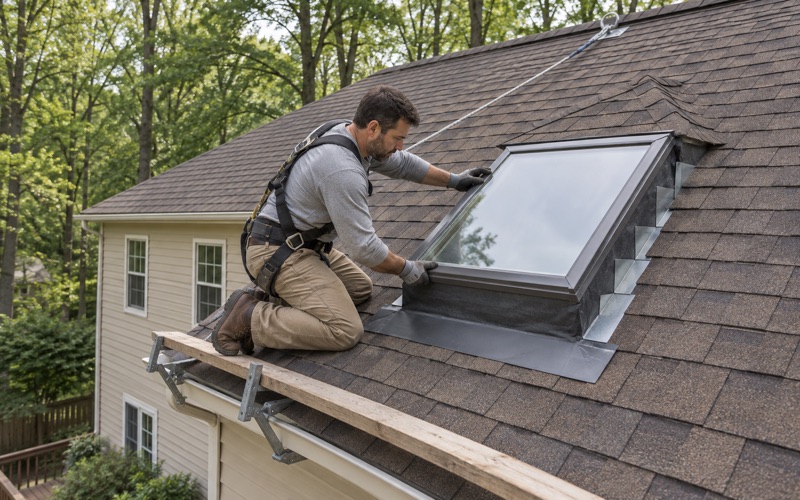
Wayne Quality Roofing has spent more than 20 years on roofing in Waldwick and across northern New Jersey, and many of the calls that matter most come in after a storm. A limb on the shingles or a tree across the gutter line changes what a homeowner needs that same evening. We plan the work around a simple order: protect the house first, then find out what actually broke.
Before anything is moved, we photograph the roof and the debris lying on it, and a tarp or temporary repair goes on the same day wherever conditions allow. Those photos become a written damage summary for the owner’s own claim. If the owner asks, someone from our crew will meet the insurance adjuster at the house and walk the roof with them.
Once the roof is dry, the real inspection starts, from the attic as well as from the shingles. Our first answer is always whether the roof can be repaired, and replacement only comes up after that question is settled. When a section or the whole roof does need replacing, the written scope separates tear-off, decking, underlayment, flashing, ventilation and gutters into their own lines.
What the National Weather Service Recorded on June 12, 2026
Two Reports Within a Minute
Waldwick’s most recent storm on the record came on a Friday evening. On June 12, 2026, a few severe thunderstorms crossed northeast New Jersey ahead of a cold front, bringing trees and power lines down across the region. The National Weather Service office at Upton, New York, logged the Bergen County damage in its preliminary Local Storm Report that night.
That report lists Waldwick twice. At 6:19 p.m., a public report through mPING said trees uprooted, and one minute later a second entry placed a large tree down blocking Summit Avenue, about a mile east-northeast of the borough’s reference point. Two entries a minute apart describe a short, hard burst of wind rather than a long blow.
What the Record Leaves Out
The report is worth reading for what it does not say. No wind speed was measured in the borough, because the measured gusts on the event page came from stations in New York City and on Long Island. No tornado was determined, no hail was reported, and nothing in the record describes the condition of any roof on any Waldwick street.
We point that out because storm stories tend to grow in the retelling. A homeowner deciding what to do about a limb on the roof is better served by the dated record and by what an inspection of that particular house shows. A neighbor’s guess about how hard the wind blew is not a basis for a repair or a claim.
Watching the Western Bergen Zone
For forecasts and warnings, the National Weather Service places Waldwick in public forecast zone NJZ103, Western Bergen, issued by the Upton office. That is a zone assignment rather than a climate record, but it is the zone to watch when a line of storms is building to the west of the county.
When a warning goes up for that zone, a quick look at overhanging limbs and clogged gutters is time well spent. A homeowner who already has a few photos of the roof in good condition also has a baseline, which makes any after-storm comparison clearer for everyone reading it, the adjuster included.
Looking for roofing closer to Verona? See Verona Roofing.
Uprooted Trees Over 1950s Houses
A Borough Built Mostly in One Decade
Waldwick’s housing is unusually concentrated in a single decade. The American Community Survey’s 2024 five-year estimates count 1,454 of 3,490 housing units, or 41.7 percent, built between 1950 and 1959. Another 349 date from the 1940s and 452 from 1939 or earlier, so roughly two of every three homes predate 1960.
Owner-occupied detached houses dominate, at 2,748 of 3,017 owner-occupied units, so the decision about a damaged roof usually rests with the person living under it. Many of those lots sit beneath mature trees, though that is our own characterization of the streets rather than a measured count of the canopy.
Why Mature Trees Change the Risk
A tree that has grown for decades beside a 1950s house can stand taller than the house is wide. When the soil is soaked and a burst of wind comes through, an uprooted trunk or a heavy limb tends to fall across the nearest roof plane or eave. Smaller branches do their own damage by gouging shingles and packing valleys with debris.
Our estimates on wooded lots call out overhanging limbs, leaf-packed valleys and shaded, mossy slopes in writing. That is no substitute for a tree professional’s opinion, but it gives the owner one document showing where the roof and the canopy meet, and which areas deserve a closer look after the next storm.
Older Roofs Hide Older Layers
A roof on a house of that age has typically been re-covered more than once. That is an inference from the build era rather than a counted figure, but it matters after a strike, because the impact can crack an original board deck hidden under newer shingles. Those layers only come into view when the damaged area is opened up.
When we do open it, damaged decking is photographed and shown to the owner before it is replaced, at a per-sheet price already written into the contract. That keeps a storm repair from turning into an open-ended bill once the old material comes off and the deck underneath is finally visible.
Tarp First, Then the Deck and Rafters
Same-Day Protection
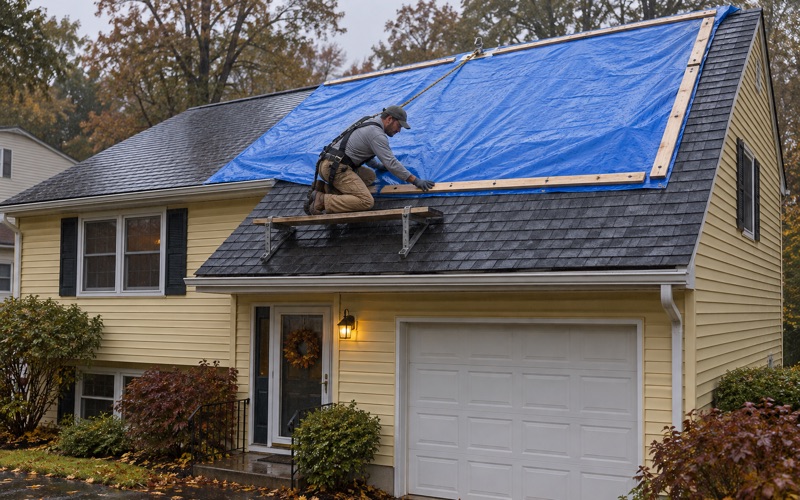
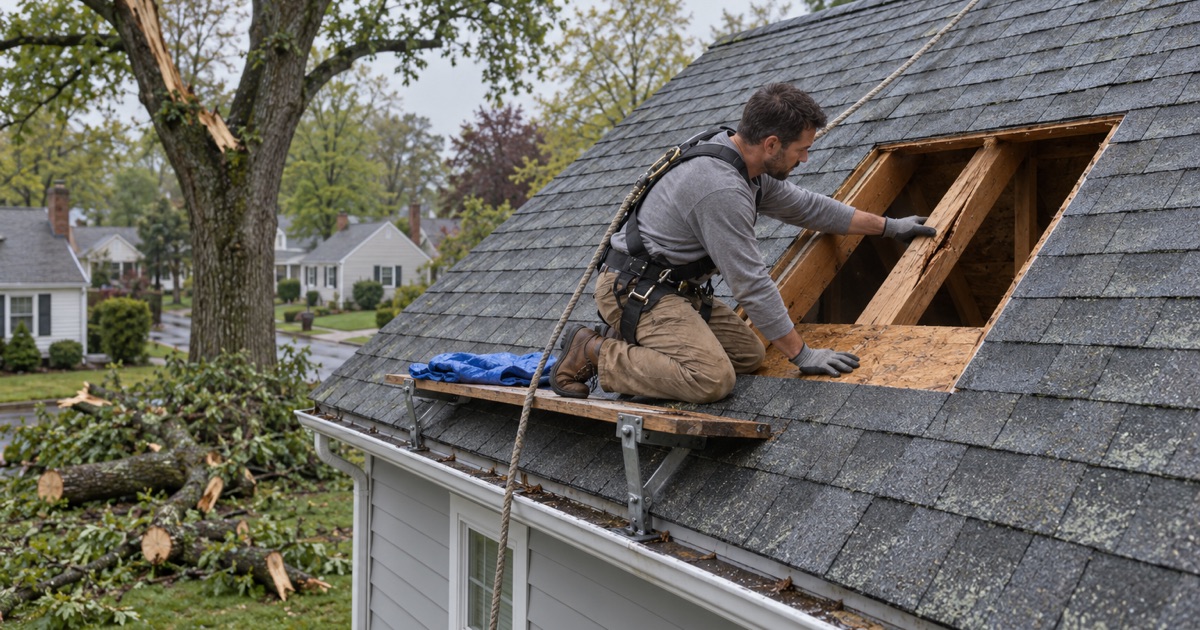
After a tree strike, the first job is keeping water out of the house. We photograph the roof before any debris is moved, then set a roof tarp over the opening or broken section and fasten it so the next rain runs off rather than under it. If a heavy limb is still lying across the roof, it has to be cleared safely first, and that part belongs to a tree crew.
A tarp is a temporary repair, not a fix. It buys time for the inspection, for the adjuster’s visit and for a written scope. It should also be checked after the next wind, because a loose edge will lift and start channeling water toward the very opening it was meant to cover.
Looking From Inside the Attic
Every storm call includes a trip into the attic. From inside we can see daylight through cracked boards, water staining on the underside of the deck, and any rafter that has split, sagged or pulled away from the ridge. Tracing water from the inside shows where it actually gets in, which is often not directly under the visible damage.
On an older house, a rafter that took a direct hit may carry a crack that runs well past the point of impact. That crack needs to be found and repaired before new decking goes on over it, or the new roof ends up resting on framing that has already given way once.
Flashing Around the Strike
Limbs rarely land neatly in the middle of a slope. They catch chimneys, vent pipes and the step flashing where a roof meets a wall, and a bent piece of metal can leak for months before a ceiling stain appears. We check chimney, step, counter and apron flashing around the strike, along with pipe boots and the drip edge.
When the repair turns into a replacement, flashing is replaced with the new roof rather than reused under it. Metal that has been bent by a falling limb and hammered roughly flat again is not a sound base for new shingles, and leaks at those joints are among the hardest to trace later.
Permits, Paperwork and the Tree Itself
The Borough Building Department
Roofing work here is handled by the Borough of Waldwick Building Department at 63 Franklin Turnpike, open Monday through Friday from 8:30 a.m. until 4:00 p.m. The office’s own FAQ says permits for roofing and similar minor work are normally issued in a matter of days.
The borough also publishes a coverage threshold for when roofing work needs a permit, and that guidance is the office’s summary rather than the code itself. We confirm with the office how each repair or replacement is treated, rather than guessing from the size of the damage, so the job is not held up halfway through.
Contracts and the Claim
Storm work is written under New Jersey’s home improvement rules, including the three-business-day cancellation notice. The photos and written damage summary are prepared for the owner’s own claim. It can help to have the contractor speak with the adjuster about what the roof shows, and we will meet the adjuster on site when the owner asks.
What a policy covers, and how the deductible applies, is between the owner and the insurer. The NJ Department of Banking and Insurance publishes storm claims guidance that is worth reading before the adjuster arrives, so the owner knows what questions to ask during the visit.
When the Damaged Tree Has to Come Down
The tree that hit the roof is a separate permit question. Under Ordinance 2024-27, effective September 10, 2024, Waldwick requires a Tree Removal and Replacement Permit from the Building Department before a qualified tree comes down, and a hazard tree still needs that permit, with no fee.
A homeowner should call the Building Department at (201) 652-5300 to confirm what the permit needs before the tree crew starts. We then set our roof schedule around the removal, so the tarp, the tree work and the repair happen in an order that keeps the house dry from the first night onward.
- 20+ Years in Roofing
- Line-Item Written Estimates
- Same-Day Storm Tarping