Wayne Quality Roofing brings more than 20 years in the trade to roofing in Wallington, and this page narrows to one part of the job that owners rarely think about until the shingles come off: the satellite dish and antenna hardware bolted to the roof. A dish that still works, a mount that held one years ago, and the mast of an old TV antenna all need a decision on a re-roof.
Before anything is priced, we start where the water does. Every leak call includes a look in the attic as well as on the roof, so a stain near an old mount is traced to its real entry point rather than blamed on the nearest shingle. If the roof can be repaired, we say so plainly, and only after that does replacement come up.
When a replacement does make sense, the written scope breaks out tear-off, decking, underlayment, flashing, ventilation and gutters as separate lines, and dish work gets a line of its own. An owner comparing two estimates can then see who planned to remove dead mounts, who planned to reset a working dish, and who left the question out entirely.
What the Borough Code and the Federal Rule Each Say
Section 365-50 and the ground-level requirement
Wallington’s zoning chapter treats household dishes as satellite earth stations. Section 365-50 says that in residential zones they shall only be installed on ground level, in the rear yard only, screened by a planting screen or fence, and kept at least 13 feet from side property lines. It also caps antennas and their mounting structures at 14 feet above ground.
Read on its own, that text keeps dishes off residential roofs. The copy of Chapter 365 we read does not show when the section was adopted, and we have seen no record of how the borough applies it to a dish on a roof. What a code says and how it is enforced are separate questions, and we only speak to the first.
The FCC rule for dishes one meter or smaller
Federal law reaches further than the borough text. The FCC’s over-the-air reception devices rule, 47 CFR 1.4000, bars a restriction that impairs installing, maintaining or using a satellite dish one meter or less in diameter, an antenna that receives television broadcast signals, or a supporting mast. It covers property within the exclusive use or control of the antenna user, where that person owns or leases it.
Under the rule, a restriction impairs if it unreasonably delays or prevents installation, maintenance or use, unreasonably increases the cost, or blocks reception of an acceptable quality signal. The rule also carries exceptions for safety and historic preservation, which we have not quoted and do not try to apply on this page.
How the two texts sit side by side
So small dishes still go up on Wallington roofs, while the ground-level language remains the borough’s written rule. We do not tell owners the local section is void, and we do not tell them a roof dish breaks the law. Both texts exist, and a question about a particular dish belongs with the borough or the provider rather than a roofing crew.
For our work the practical point is simpler. A roof may legitimately carry a working dish today, and the same roof may carry hardware left behind by dishes and antennas that came down long ago. Both need a plan before tear-off starts, because each one changes what happens at the deck.
Looking for roofing closer to Hasbrouck Heights? See Roofing in Hasbrouck Heights.
Abandoned Mounts as Leak Points
How a mount is fastened through the roof
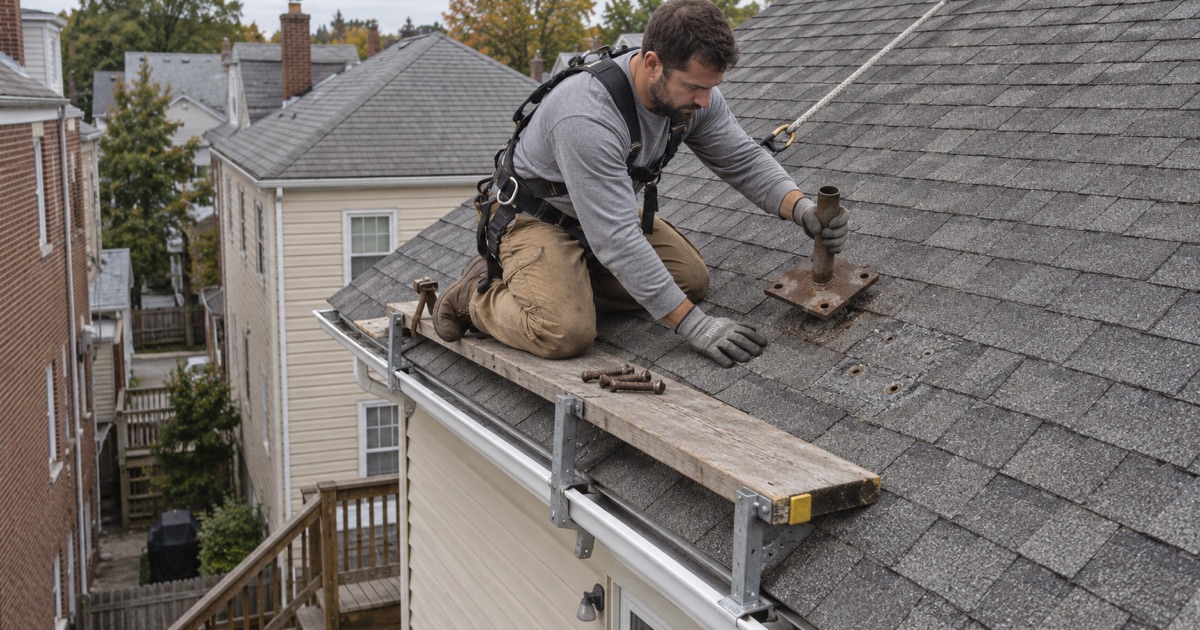
A dish or antenna mount is usually fastened with lag bolts driven through the roof covering into the deck below. When it went up, the installer may have sealed around those bolts with a dab of sealant and nothing more. That sealant dries and cracks over the years, while the bolt holes stay open to whatever runs down the slope.
An antenna mast adds more holes: a base plate, sometimes guy-wire anchors spread across the field of the roof, and brackets at a chimney or gable end. Each one is a penetration that was never part of the original roof design, and each one depends on a seal that nobody has looked at since the antenna stopped mattering.
Older housing, older hardware
According to the 2024 American Community Survey, 74.5 percent of Wallington’s housing units were built before 1970, and homes of that age have lived through more than one generation of TV reception. A roof here can carry an antenna base and a dish mount from different decades, a few feet apart, with neither in use.
Nobody has counted how many roofs in the borough still hold abandoned mounts, and we will not guess. What we can say is that a dead mount is a leak point waiting for its sealant to give out, and that a re-roof is the natural moment to deal with it once and for all.
Tracing a stain back to a mount
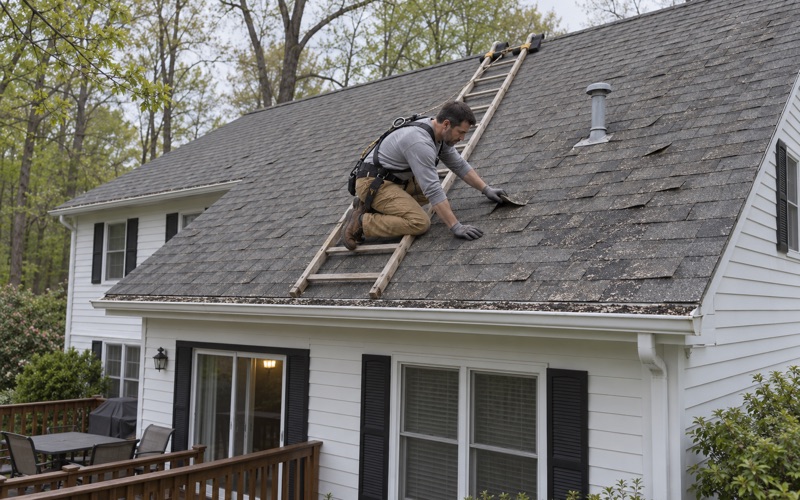
Water from a failed mount rarely drips straight down. It can run along the top of a rafter or the underside of the deck and show up as a ceiling stain several feet away from the bolt that let it in. That is why our leak calls include the attic: from inside, a dark ring of wet decking around a lag-bolt tip points right at the source.
If the leak comes from a single mount on an otherwise sound roof, the answer may be a repair rather than a replacement: pull the mount, seal or patch the holes, and replace the shingles around them. We tell the owner that first, before any talk of a new roof.
Removing or Resetting a Dish During a Re-Roof
Taking dead mounts off for good
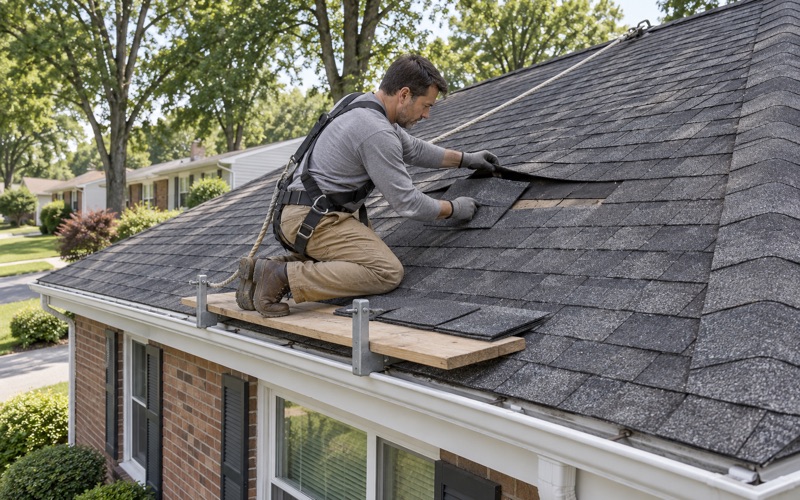
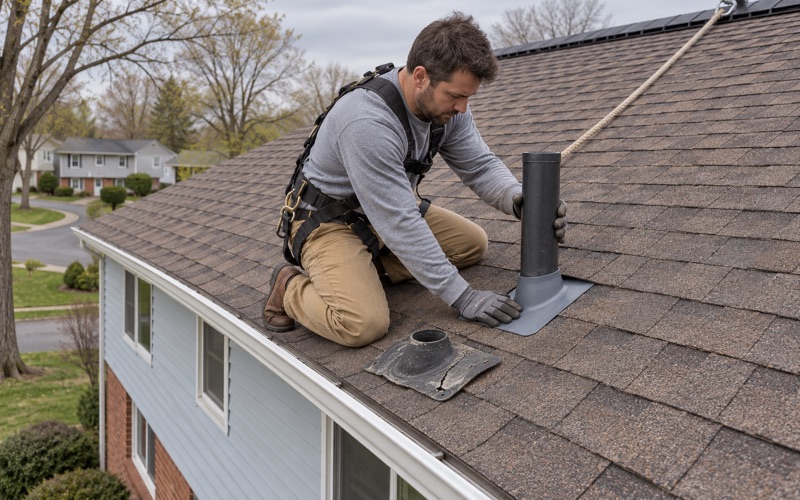
On a full replacement, abandoned mounts come off during tear-off rather than being shingled around. Once the old covering is gone, every bolt hole in the deck is plain to see. Small, clean holes are sealed; where the wood around them is soft or split, that section of decking is patched or replaced.
Damaged decking found this way is photographed and shown to the owner before any of it is replaced, at the per-sheet price written into the contract. Nothing gets buried under new underlayment without the owner seeing it, and the photos stay with the job paperwork.
Resetting a working dish on a flashed mount
A dish the household still uses is taken down before tear-off, set aside, and put back once the new roof is on. We return it on a flashed mount, where the base sits on flashing woven into the shingle courses so water is carried over the penetration instead of relying on sealant alone.
Where the old location was poor, such as low on the slope where water collects, the owner can choose a better spot. That choice goes into the scope so the mount base is built in while the new roof goes on, rather than drilled through finished shingles afterward.
Re-aiming belongs to the provider
Once a dish is reset, its signal has to be re-aimed, and that is work for the household’s service provider, not for us. We are not a satellite installer and we do not promise reception. Our part ends with a sound, flashed mount in the agreed spot and the dish set back on it.
Owners save a step by calling the provider before the roof starts, so an appointment can be booked for the days right after we finish. We put the expected finish date in writing so that booking lines up with the end of the job.
Two-Family Roofs With Two Households’ Equipment
One roof, two sets of cables
The same survey puts 37.0 percent of Wallington’s housing units in two-unit buildings, so a typical roof here sits over two households. Each floor may have had its own dish or antenna at some point, and a two-family roof can carry equipment belonging to both the owner and the tenant.
Before tear-off we sort out which dish serves which unit, which mounts are dead, and who wants a dish back. Cables are tagged at the roof edge so a working line is not mistaken for an abandoned one and cut during removal.
Whose roof, whose dish
The federal rule speaks of property within the antenna user’s exclusive use or control. On a two-family house the roof is usually shared, so whether a tenant’s dish goes back up, and where it sits, is for the owner and tenant to settle between them, not for us to decide on the roof.
We put the answer in writing before work starts. If a dish is coming down for good, the scope says so; if it is going back up, the scope names the location of its flashed mount and which unit it serves.
Keeping both floors informed
A re-roof on a two-family house means two households hear the tear-off and may go without dish service for a few days. We give the owner a written schedule to share with the tenant, and the driveway, yard and gutters are cleaned at the end of each work day, including a magnet sweep for roofing nails.
Contracts are written to New Jersey’s home improvement rules, including the three-day cancellation notice. If the house is headed for sale, we can also provide a written roof condition report noting where old mounts were removed and how their holes were closed, for the seller to hand to the buyer’s inspector.
- 20+ Years in Roofing
- Line-Item Written Estimates
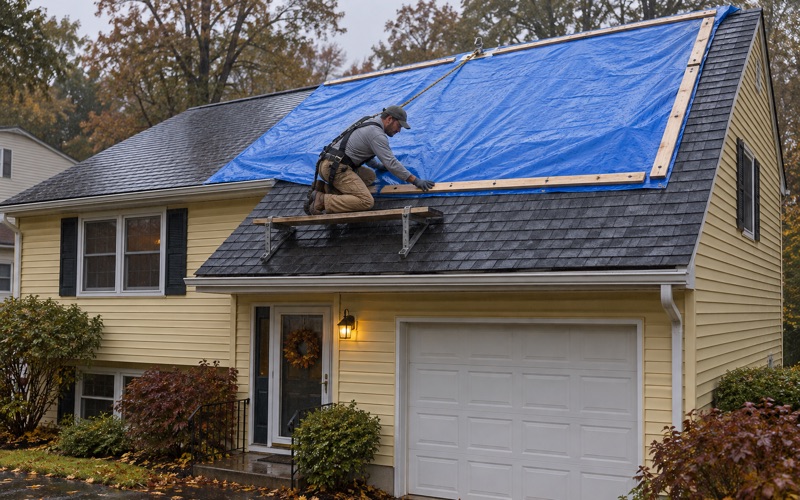
- Same-Day Storm Tarping